











If you haven’t figured it out by now, I like to use a provocative “headline” to grab your attention, and sucker you into clicking that button to read my column. The headline will generally be related to the content, but in ways you might not expect. If you’re reading this, you fell for it!
Seriously, I’m beginning to get a case of heartburn over “stabilized approaches,” and I want to kick the subject around a little. I think there is widespread misunderstanding, it’s getting worse, and it is not safe.
The confusion comes from two different definitions of “stabilized approach.”
There is the “stabilized approach” for jets.
There is the “stabilized approach” for props.
They are not the same! For the record, I like them both – each in their proper place!
They are different because of the different characteristics of the two types of propulsion, and the different aerodynamics of straight and swept wings.
Even the FAA recognizes this, explicitly stating in all the PTS (Practical Test Standards) booklets:
STABILIZED APPROACH
The term “STABILIZED APPROACH” as used in this practical test standard is not intended to be construed in the same context as the term utilized in large aircraft operation. The term as utilized in this book means that the aircraft is in a position where minimum input of all controls will result in a safe landing. Excessive control input at any point could bean indication of improper planning. (FAA-S-8081-5C “Airline Transport and Type Rating Practical Test Standards”)
That’s very simple. I think it means that if you have to start “yankin’ and bankin’,” or making big power changes to get where you’re going, it’s not stabilized (by either definition).
In my opinion, that “large aircraft” should read “jet aircraft.” In the FAA’s “corporate culture” today, “large aircraft” are jets, and way down at the bottom of the barrel are those pesky recips, which most in the FAA wish would just go away.
Why Two Types of “Stabilized Approaches”?
D. P. Davies, author of the classic book “Handling the Big Jets,” makes this very clear, subtitling his superb work with:
“An explanation of the significant differences in flying qualities between jet transport aeroplanes and piston-engined transport aeroplanes together with some other aspects of jet transport flying.”
Words are inadequate to express my admiration for this book. It should be thoroughly studied and re-studied by everyone flying jets, even if the author can’t spell “airplane!” (Davies is, of course, British.)
Little Props and Big Props
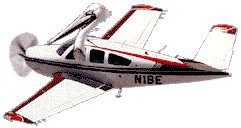
Carefully, now. There are some very minor differences between small and large prop aircraft, but essentially, the flying techniques used in a Bonanza will serve well in flying a DC-6, and those for a Cessna 185 will work very nicely in a DC-3.
Little Jets and Big Jets
There are some very small differences between small jet aircraft like the Citation or Lear Jet, and the “Very Large” aircraft like the 747, but again, they are more alike than different.
Jets vs. Props
But as Davies points out, there are many, and very large differences between “jets,” and “props,” and this is the area I’d like to focus on in this column, with particular attention to the “stabilized approach.”
In the Beginning …
Let’s start with a student pilot. Unfortunately, flying today has become very expensive, and very complicated by rules, by airspace, and by communications and new navigation techniques. Of necessity, it seems, we are spending less and less time on teaching good old “stick and rudder” skills. We take the “canned” approach to the basic flying, keeping it very simple, while spending more time on the rules, talking on the radio, and handling Class B airspace. All this with an eye towards getting the trainee through the government-approved course in the minimum amount of time, at minimum cost. Fifty years ago, it took forty hours minimum to attain the Private, and the legal requirement remains the same today. Something “gave” in there, and I believe basic flight skills went down the tubes.
In the pressure to gain certification, certification itself often becomes the only goal, and we forget the basic purpose of all this, which is learning to be a pilot. Today, we don’t care how well a pilot flies, as long as he knows the rules, communicates well, and can handle Class B airspace.
One Size Fits All
The FAA hasn’t helped much, because they too have taken the “canned” approach by carefully defining the tasks and maneuvers needed to earn a Private, Commercial, or ATP certificate and associated ratings. The end result is that everyone, students and instructors alike, begin to believe that once a trainee can successfully complete the highly “canned” maneuvers in the PTS with an examiner/inspector watching, he is fully qualified as a pilot at that level. I don’t think so.
Take the student pilot, learning traffic patterns and landings. He is generally taught one “normal” configuration, one “normal” speed, and often, one “normal”power setting for the downwind, base, and final, from one “normal key point” (abeam the numbers?). Or perhaps a different setting for each leg of the pattern. By default, anything and everything else is “abnormal,” and “abnormal” to a student often equates to “emergency,” a “pulse-pounder.” At some training airports, power-off approaches are nearly impossible, because everyone is playing “follow the leader” who is simulating a 747 pattern with a 152, with some sort of idea about his own “stabilized approach.”
This is all fine for “initial training,” but the problem is that many of today’s pilots go on doing that “forever,” locked into a pattern enforced by their own ignorance, by the “traffic pattern nazis,” and by inexperienced CFIs, who themselves never learned anything outside “the usual.”
Or, take the instrument student, taught to make all approaches at one canned airspeed, power setting, and configuration, with a long “stabilized” final, perhaps from the outer marker. Only way to do it, right? Just like “the big boys,” right?
Crutches Forever
Simplification at the elementary level is fine, but unfortunately, I think too many pilots stay at the elementary level for far too long. The first time SoCal Approach tells our new instrument pilot “Bonanza 123A, maintain 120 knots to the marker, cleared for the approach,” the pilot will panic, because he’s only done ILS approaches at 90 knots. The properly trained Bonanza pilot, when entering airspace like that, might helpfully volunteer, “SoCal, Bonanza 123A can maintain anything up to 180 knots to the marker,” and then do it without a care in the world, because he’s been trained (or has trained himself) to do whatever it takes. He’ll hit the GS at 180, reduce power and start down, somewhere around 1,500′ or 2,000′ AGL he’ll slow to gear speed, extend the gear, and finish up the final stages of the approach at 100 knots, or 120 knots to DH. It’s not hard, you just have to do it a few times to pick up your timing, and get comfortable with it. You’ll also get a kick out of it when SoCal says “Bonanza 123A, reduce speed to 140 now, you’re overtaking a 747.”
Does that approach qualify as a “stabilized approach?” Sure it does, in props, although I grant you, it may be approaching the limits of the definition. You planned it that way, no unexpected or large control inputs were needed, just one smooth maneuver, all the way. If the needles go peg-to-peg, or the airspeed drops so badly that you have to jam on lots of power, then you get an overspeed, and have to correct that, that is “unstabilized,”- in props.
When do we learn this “advanced technique?” It’s a little hard to do it in the training for the instrument rating, because it runs up the hours needed, as well as the cost, and complicates getting the rating. However, once most pilots get the rating, that’s the last they’ll see of an instructor until the next Flight Review or the next rating. It’s a dilemma.
OK, OK, Just What Is a “Jet-Stabilized Approach?”
The FARs do not help with the definition, nor does the AIM, for this is only for jets, generally only in airline-type operations (I include 135 and corporate jets). The only place I know that we’ll see a definition is in the individual airline’s training program, or the company operating manual. There, you will find a near-universal, worldwide definition, which probably includes the following for “normal conditions” (some wind corrections to the speed exist, but let’s not clutter things up, here):
Gear Down, Landing Flaps set, all checklists complete,
On course, on glide slope (electronic or visual),
At the landing speed, in final trim,
Thrust set and stabilized to maintain all that,
All this is maintained from the defined point, right to the flare, only tiny corrections allowed.
All those requirements are required to be established and stabilized at or above some stated altitude. If all that is not done and “stabilized” by the specified altitude, the pilot is required to execute a missed approach, and try again. I’ve never seen that altitude specified at less than 500′ AGL (usually that low only for visuals), most airlines specify it in the 1,000′ AGL range, and I’ve seen it specified as high as 1,500′.
One simulator instructor I know can manhandle the 747 simulator to a point at about 1,000′ AGL on an ILS, let go of everything, slide the seat back, turn sideways, and fold his arms, while the airplane heads on down the ILS, and lands itself on the runway- without using the autopilot or touching a thing. Now, that is a truly “stabilized approach” (for jets), in the strictest sense of the term! That would be the ideal to which all jet pilots should aspire, though they would do well not to slide the seat back, turn sideways, etc.
Why So Picky in Jets?
Now, this makes for a long, boring final. Why do we do it this way? Early in the jet age, we lost several airplanes because pilots tried to fly them like the prop airplanes they’d flown for years. They’d come sailing down the ILS, bleeding speed off all the way, running the flaps out, gradually reducing thrust, cross the fence on speed at idle thrust, and land, thinking they’d done a good job. Jets were so slippery, compared to what they’d been flying, they usually ended up fast, rather than slow.
But, a couple ended up in trouble. One scenario is where the pilot is “too high, too fast” and makes aggressive corrections, idle thrust, an early gear extension (noisy for the passengers!), more flaps, and sooner, maybe even cheating a little with speed brakes, usually not used when flaps are extended.
He properly dives for the glide slope first, and gets on it, but he’s still too fast, so he leaves the thrust at idle to slow down. Finally, the speed drops into the ballpark, everything falls into place, he heaves a sigh of relief, calls for the final checklist, and shoves the thrust levers up to “catch” the speed, just like he would have with big radials and props he’s flown all those years.
At that point, he’s dead.
Do you see the picture? Maybe a little cocky that he has “saved the day” from that “hot approach,” he calmly pushes the thrust levers up – and nothing happens! The early jets took at least eight seconds to go from dead idle to any significant thrust, and eight seconds becomes infinity when you needed thrust a second or two ago. By this time, the speed is really dropping, because now he’s nose high, lots of drag, deep into the Back Side of the Power Curve. Next mistake, he’ll ease the nose up just a bit more in an attempt to keep things going while the engines do their agonizingly slow spool-up. But, a swept-wing jet is different from a prop airplane at that point, pulling the nose up will quickly kill more speed, which will dramatically reduce the lift, and the airplane will almost instantly begin a high rate of sink, quickly building to thousands of feet per minute (if there’s room). A really good demonstration of this at altitude is terrifying, I cannot imagine the horrible feeling of seeing it from a low altitude, in the final seconds of life.
(A side note here, this is not the so-called “deep stall,” it is simply a “high sink rate.” Different animals.)
What Did He Expect?
Let’s say this early jet pilot had just made the transition from the DC-6, or a Lockheed Constellation, both four-engine, reciprocating-engined, propeller-driven airliners. What did he expect of this shiny new jet, and why didn’t he get it?
There are a number of things, but the important ones are these. First, he was unable to get the drag he was accustomed to all his flying life, which he needed to slow down. Jet engines at idle don’t make drag, like windmilling props do. Next, his jet engines did not respond instantly, as the big old radials would have. Finally, even when the jet engines do spool up, they produce only thrust, while the prop airplanes produce a large amount of “instant thrust,” and a lot of “instant lift” by blowing all that air over a very large portion of the wing. That sinking jet airliner can produce all the thrust in the world, but until that thrust is translated into more speed (for lift), it’s going to keep right on sinking.
(Yes, some of the modern military aircraft can haul the nose to vertical, slam it into afterburner, and accelerate straight up, riding thrust alone, but we’re talking jet transports, here, with thrust-to-weight ratios of 1:3 or 1:4, not 1:1 or better.)
Grim picture. It took several crashes before the aviation industry sorted it all out, and came up with the procedures listed above to prevent this from happening again. The “Jet Transport Stabilized Approach” has been highly successful – in jets.
For Jets Only!
I want to hammer the point home here that these “new procedures” were not improvements for flying in general, but different procedures, required only for the jets, because of their different characteristics. I make this point because I believe some or all of these “jet procedures” have filtered back down into the general aviation world, and are being used in propeller-driven airplanes, usually unnecessarily, sometimes to the detriment of safety. In fairness, some parts of the jet procedures CAN be used in props with good results.
The solution to the problem (for jets) was primarily “The Stabilized Approach.” This set things up early, and it created a fairly high drag condition, so that a fair amount of thrust was required to maintain flight. By doing this in jets, we stay away from idle thrust (when close to the ground). A key point here is that jet aircraft can afford to do this, because they have a huge margin of thrust available at low altitudes, and even a small amount of additional thrust is sufficient to blast them right into the go-around, even with gear down, full flaps, and even an engine out. Any variations in thrust required to fly the glide slope are always well above idle.
Most (all?) jet aircraft were also modified with a “high idle” setting triggered by any flap extension, so that even if the pilot pulled the thrust levers all the way back with any flaps at all, the engines would idle fast enough to be able to accelerate very quickly to maximum thrust. Good modification, I think. If only the early 727 had had it, we might not even be having this discussion today.
Turning to Props (Including Turboprops)
Assume a light single, stalling speed about 60 clean, about 55 with full flaps. I have seen people slow down on the 45-degree pattern entry, get the gear down, and set half flaps, slow to about 80 or 90, and get their checklist done. Good procedure,right? You’ll fit right into a busy training pattern, and don’t have anything left to do but extend final flaps. You may even be forced into this, if the pattern is really busy. “If you gotta, you gotta,” but that doesn’t mean it’s a good idea everywhere, all the time. It may well be a good procedure if you’ve never flown a complex airplane before, or the particular type.
Oops, the Engine Just Quit
What’s wrong with this approach? Well, try failing the engine. You will find that with all that drag, and such a slow speed, you’ll have to shove the nose down hard to maintain any decent speed, and from 800 ft., you’ll be in the trees before you know it. You might get to choose which tree, but you won’t have many options. If you do this with a twin, and an engine quits, you’ll need to not only handle the engine failure, but get the flaps and gear back up for single-engine flight, then only seconds later put them right back down again, for the landing. See how that affects your workload! And, where does it leave you on your checklist? Is this the best we can do?
Why not come “coasting” into the 45 at 120 knots, or even 150, “clean?” That “stores energy,” so that if the engine quits, you have far more time, and far more options than the trees right below you. With only a small modification to the pattern, you may even have enough energy left to make your intended runway. If you really feel this is hazardous when mixing it up with the trainers, then how about using the “high performance” TPA (Traffic Pattern Altitude) of 1,500 ft.? If you do this, you’ve got another 700 ft. of altitude to play with, too! If you’re going to use the speeds of the “large aircraft,” doesn’t it make sense to use their TPA, too? There’s rarely anyone there, and from that “high perch” you can see the little ones below, and can pick your “slot.”
OK, here we are on the downwind, abeam the numbers, speed still dropping, low power, and there’s no one ahead of us. Gear down, complete the checklist, play the turns so that you need no additional power to get to the runway, adding flaps as needed when the speed gets too low without them. Play this so that you touch down on the numbers, a few knots above the stall. Any time during that approach, if the engine quits, you might skip the flaps (drag), and still make the runway. Pulling the prop all the way back will extend the glide, and if you’ve got quick gear, pulling it up will assure making that nice runway, even if you do put it on the belly. That’s a whole lot better than an off-airport landing.
Yes, that means a “decreasing speed” approach, all the way. That’s utter anathema in jets, but highly desirable in props, in my opinion.
Same thing for an ILS. Shoot it at 120 or better, as clean as you can, maybe with only the gear down (gear up will work, but it gets a little busy at DH). Make sure you keep it on, or above the glide slope, there’s not a thing in the world wrong with deliberately flying the glide slope a dot or more high, it won’t make you go blind, and it won’t grow hair on the palms of your hand. That extra angle gives you “more energy.” Breakout at DH, power off, handle the drag to land as you did above. If this forces you to land a little long, so what? Most ILS runways are plenty long enough to land in the last third, and the big jets aim for the 1,000 ft. point, are prohibited from touching down in the first 500 ft. Why are some of us so anal about planting a Bonanza on the very end?
No Flaps, Please
Oh, you don’t like that last-minute configuration change, you say? Fine, land without the flaps, then!
Why do we use flaps so much, and so often, anyway? The difference in the stalling speeds of a 182 between “Full Barn Door” flaps, and no flaps at all is all of just SIX KNOTS! Check the POH for one of the light trainers, you’ll find it’s often down in the TWO KNOT range! Using full flaps tends to make the airplane land nosewheel first, it makes the elevator forces very heavy in some (Cessna 182), and if you trim too much, it makes the airplane pitch up too hard on a go-around. All are traps that can be avoided by landing with partial flaps, or none at all. Go out and shoot some landings on a nice calm day, using varying degrees of flaps, with an eye towards speed at touchdown, and landing roll. Take an observer along, and have him call the GPS speed, so you’re not misled by static error in the IAS, caused by the different attitudes. Then c’mon back and tell me just why so many use full flaps on a 10,000 foot concrete runway? Yes, if you’re planning to put that 182 into a 600 foot strip, then you probably want full flaps, and some practice, too, before you do it.
Becoming a Pilot, At Last
There is another benefit to all this. By flying your airplane in a variety of ways, you learn more about your airplane, and more about yourself. You extend the performance envelope. That is “a Very Good Thing,” and is another step towards making you a “Real Pilot,” instead of just someone with a certificate. There are lots of certificates out there, but we’re running short of pilots.
Be careful up there!