



















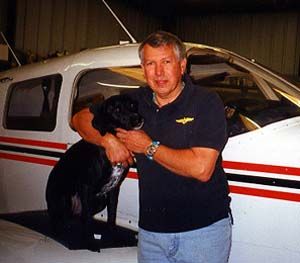
Norman Lyle Prouse was born September 29,1938, in Wichita, Kan. He won his first airplane ride by writing an essay for his father’scompany, Beech Aircraft. After high school he joined the Marines, learned to fly, andstarted a family. In his 13-month tour in Vietnam he earned seven air medals. He resignedhis commission and took a job at Northwest Airlines, where he spent 22 years risingthrough the ranks to the Captain’s seat of a 727.
On March 7, 1990, Lyle and the crew hit the Speak Easy bar in Fargo, N. D., for a fewdrinks. They had more than a few, and got rowdy enough to cause another patron of the barto make an anonymous tip to the FAA. When the next morning’s uneventful flight landed atMSP the crew was arrested and charged as the first violators of a 1986 federal law whichcriminalized operating a common carrier under the influence of drugs or alcohol. Lyle losthis job, felt shame like he never knew, entered an alcohol treatment center and brieflyconsidered suicide.
A month later he was sober and recovering, while professionally things got worse. TheFAA revoked his certificates, he was convicted of the felony and sentenced to a federalprison, he was told he could never fly again, and he went broke. Taking it one step andone day at a time, he began regaining his certificates and restoring his reputation. Likethe essay that won his first airplane ride, a sincere and repentant 11-page letter toJudge James Rosenbaum, the trial and sentencing judge, won him the right to attempt whatnearly everyone considered impossible — the reacquisition of all his licenses. Sanctionsplaced on him by Judge Rosenbaum were lifted and the long journey back began. After he hadearned his licenses for the second time, Northwest CEO John Dasburg, himself a child of analcoholic parent, rehired Lyle to work for a year in the training department. From therehe transitioned to line flying as a first officer, and retired as a 747 Captain on his60th birthday in 1998. Now he logs a couple hundred hours a year in his 1975 PiperWarrior.
Lyle’s not an evangelist and doesn’t seek publicity but he is willing to share hisstory with pilot groups and recovery fellowships in hopes that he can help someone realizesobriety.
When was your first airplane ride?
I won an essay contest when I was about 12 years old. My dad worked at Beech Aircraftin Wichita and I won a contest for employee’s kids about why I wanted my dad to worksafely. The whole family got to go up in a Beech Bonanza with the chief test pilot forBeech. We got a 40-minute ride around Wichita. Some years later I flew out to Marine bootcamp on a Lockheed Constellation and those were my only two flying experiences until Ilearned how to fly in the Marines. I trained in Pensacola, Florida and Beeville, Texas,where I met my wife, then we moved to the Marine base at El Toro, California for about twoyears. From there I went to Vietnam for a 13-month tour.
I was in a tremendous squadron with tremendous personalities and tremendous flyingtalent. I think all Marine squadrons are probably good but the one I was fortunate toserve in was outstanding. We have a reunion every other year and there’s a feeling ofcamaraderie that words don’t do justice to. Those guys I flew with in ’65 and ’66, we’reall older now and we have different perspectives on things, but when we’re together Istill feel like a young Lieutenant seeing them as they were.
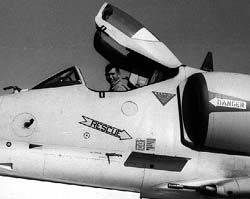 A4E Skyhawk, VMA-311, ChuLai, Vietnam; 12/65 |
How did you get from the Marines to Northwest Airlines?
I was never an airline type. I was a lifer, a career Marine officer. The day I got mywings and commission was February 25, 1963, my wife Barbara’s 20th birthday, and shepinned the wings and bars on me. All I wanted to do was stay in the Marine Corps and fly.I earned a regular commission, and those were very competitive. I was surprised to get onewith as little formal education as I had. As time went on, I could see that I was going tospend four to six years away from my wife and kids. Based on the family I grew up in andmy experiences there my commitment was to my wife and kids to see that they got everythingI hadn’t gotten. I was a flight instructor at the Advanced Jet Training Command when Iresigned my commission and there was a one-year freeze on my resignation. I completedanother year as a flight instructor in Kingsville, Texas and then joined NorthwestAirlines in August 1968.
I did everything I could not to go with the airlines. Coming from an extremelydynamic flying environment, I thought the airlines might be boring. I checked into goingto Australia and Alaska to do some bush flying. Those didn’t seem very likely, so I didstart canvassing the airlines and, based purely on choice of domicile, I went withNorthwest. Some of the guys made a real science out of debt-to-equity ratios and projectedgrowth and made their choices on that. I’m a more gut-reaction, visceral sort of guy and Iwent with Northwest because I was either going to live in the Twin Cities or Seattle.
I started in the normal bottom-rung starting position as a flight engineer, or what weat Northwest called a second officer, on the 727. We also had a limited number of L-188Electra turboprops and Northwest would just draft probationary pilots from time to timeand just assign them to those flights. It was their way of getting a cheap co-pilot and itwas great for me because I didn’t care for sitting in the back at a flight engineer panel.We flew through a lot of mountain stations in Montana and out West, and I loved that kindof flying. I did that for about a year.
In those days Northwest was still called Northwest Orient. Did you fly overseastrips?
No, I was strictly junior. The overseas flights went out of Seattle in those days andSeattle was so senior it was like a separate airline. I stayed in Minneapolis for thefirst eight years, then as the concept of commuting became more popular, we moved toGeorgia where we live now.
What was going on in your life that led to that night of drinking in the Speak Easybar in Fargo?
By way of background, both my parents died from alcoholism. I had a very narrowdefinition of what an alcoholic was. I defined it by what I had seen at home and what Ihad seen in the Indian community in Wichita. Although I drank pretty hard, I really didn’tthink I was an alcoholic. My buddies in the Marines drank hard, and my buddies at theairline drank hard, and it wasn’t until later that I learned the difference betweenabusing alcohol and being an alcoholic. Alcoholics begin by using alcohol, then abusingit, and after a long, subtle, insidious process, we become alcoholic. The numbers Ilearned in treatment are that out of every 10 people in the United States, seven peopledrink. Out of those seven people, two are social drinkers and the other five abusealcohol. Out of those five one will become alcoholic. If I had known that, and even if Ihad believed it, I would never have thought the one person was going to be me.When mybuddies and I drank at the Officer’s Club, near the Twin Cities airport, I would havebelieved that one of the other four would eventually have been the alcoholic. Many of themwere getting divorces, having the occasional DUI, and experiencing other difficulties Iwas not then experiencing. I had what I thought was a solid case against me ever ending upas an alcoholic.
I didn’t behave like my parents and other alcoholics that I knew, so I was convinceddeductively that I wasn’t one of them. I didn’t drink every night. I hardly ever drank inthe morning. I didn’t stay drunk for two or three days at a time. I didn’t beat or abusemy kids or my wife. I didn’t do a lot of the things that I thought all alcoholics did. Astime went on my friends’ drinking began to subside, but my tolerance increased and Iwasn’t aware of that. Eventually I slid into the disease of alcoholism. On March 7th Icelebrated 10 years of sobriety. In that time I’ve met thousands of alcoholics whosehistory is identical to mine. They came out of an alcoholic family, hated what the alcoholhad done, and said ‘I’m never going to be like that’ and still ended up alcoholic. Thatjust butresses the scientific argument that there’s a genetic connection.
Early in our marriage my wife and I had two boys. After joining Northwest we adopted alittle girl when she was 17 days old. She became the center of my universe and when shewas 17 years old, she ran away from home. My mind reacted as it had during my childhood,when subconciously I saw all the conflict, the chaos, and the back and forth journeys Imade in my family as constant and continual events of abandonment and betrayal. And thiswas the greatest and most painful abandonment and betrayal of all and I could not, and didnot, handle it well. I drank real hard for those two years which immediately preceded theFlight 650 incident. I usually drank alone so it was unusual for me to be drinking withthe other two crewmembers in March of 1990.
What shape were you in when you showed up to fly the next morning?
I was hungover and I felt it. The prosecution said I was willing to sacrifice the livesof the passengers in order to retain my job, but that wasn’t it at all. I had flownhungover many times in the service. A lot of us did. We’d be out partying hard then we’dgo out and fly hard the next day. It wasn’t a daily thing, but it also wasn’t unheard of.The way I felt that morning I knew it was going to be a long day, but there was absolutelyno doubt in my mind that it was going to be a safe flight. When I look back on that now Iclearly know that I endangered the lives of 58 people.
Alcoholism is a three-pronged disease. It’s physical, it’s mental and it’s emotional.All three axes are affected by the disease, and they’re effected even when one is not inthe act of drinking. That doesn’t mean that I’m not capable of rational thought, such asevaluating a business deal or deciding whether to buy a home, but when it comes to alcoholI lose my ability to think rationally. I began to think that I can drink and always workaround it, regardless of what else is going on. I do not believe I’m hurting my wife, mykids, or my friends; or my employer or the public. It’s part of the insanity of alcoholismfor me to think that I can drink, be hungover and still fly safely. Yet back then, Iabsolutely believed that. No matter what happens I will work to find a way to drink aroundmy situations. I’ll bid trips where locations and layover lengths will allow me to drinksafely, and I’ll figure out other ways to be "more careful," but the idea ofeliminating alcohol will never be part of my thinking. I will identify "theproblem" as being where and how to drink without getting caught or in trouble, but Iwill NEVER see the alcohol as being THE problem.
Many who read this will have great difficulty understanding what I’m saying but thereare two groups of people who won’t — those who are actively alcoholic and those who arerecovering from alcoholism.
How did the FAA get involved?
One of the crew members had angered one of the bar patrons and he made an anonymouscall to the FAA about us. So an FAA inspector met us the next morning and asked about acrew that had been drunk the night before. I responded that we had been drinking but wehadn’t been drunk. I look back at that now and it was an absurd statement. The FAAinspector was talking about the eight-hour rule, and I honestly thought we were all okayon the eight-hour rule. So I wasn’t sure if that was the issue or impairment was theissue. But he never talked about us not being in any condition to fly. He just kepttalking about the eight-hour rule.
The second officer, the guy who had caused most of the problems in the bar, had missedpickup. We had pushed pickup back as a courtesy to the flight attendants and he stillmissed it. So the co-pilot and I had already done the walk-around and pre-flighted hispanel when he finally showed up. We told him to get settled and tell us when he was readyto go. So with all that unfolding we weren’t sure what to do, but we ended up taking theflight.
What was the flight like?
Uneventful except for nasty weather conditions in the air and nasty conditions on theramp. We had the worst gate on the whole airport to park into, with aircraft on eitherside. And I had no trouble doing it. All of the physical tests that you want to apply werepassed, but I still can’t justify us taking that flight.
Until the day I retired people would come up to me and say "That whole thing waspolitical. They wanted to use you as an example." I’m aware of many situations worsethan mine from a legal standpoint in which the sentences were much, much lighter. I wasaware that there was indeed a strong political undercurrent in much of what took place butI brush that away as almost irrelevant. Because the bottom line is that I have to own myactions, my behavior and my choices and without the ones I made in Fargo absolutelynothing could have happened to me. I must accept responsibility, period, and I do.
I told people, in response to their comments, "You may have the luxury of thinkinglike that. I do not. I can either be a victim or a victor, but not both. If I ever flirtwith the idea that ‘they’ did all this to ‘me’ then I become a victim … and I refuse tobe a victim." I am not even the victim of alcoholism because I have chosen to dosomething about it — I am recovering. Remember, this is Alcohol-ISM, not Alcohol-WASM,and it’s a lifelong process, which I welcome.
How soon did you seek treatment?
On the day I returned home, which was the day after I was arrested, I saw two doctors.The first one was a family therapist and he referred me to the second who was a specialistin addiction medicine. After talking with me for 45 minutes he said "You’re analcoholic and you need to go into treatment right away." That’s what I did. I drovestraight to the treatment center with the clothes on my back. I had come from a backgroundin which one doctor said in a report "…given the history of this man there is noreson to believe he should ever have become a productive member of society." Yet Ihad accomplished many things, always against the odds, and I had taken many risks andreaped many rewards. I had climbed to the highest rung on the ladder and in the darkestmoment of my life I had lost it all. As I saw the sign at the front of the treatmentcenter it was as though a giant eraser swept across the blackboard of my life and wipedout every single accomplishment of 51 years; my self-worth was zero and I wanted to die.
I had not lived to bring shame to anything around me. Not to my family, my MarineCorps, my country, my airline, my profession, or my Indian heritage. To the contrary, Ihad worked hard to bring pride and honor to each of those. Yet when this occurred Idisgraced and shamed everything I loved and treasured … and it shredded me into amillion pieces. I found myself considering suicide, something that most of my friends nowwould find hard to believe. I had never thought of suicide before, except in Vietnam whenI wondered if I would ever allow myself to be taken captive if shot down … and I hadnever resolved that issue.
Somewhere in the treatment process I found myself thinking more about living than dyingand I do not know when that began to occur.
How long was your treatment?
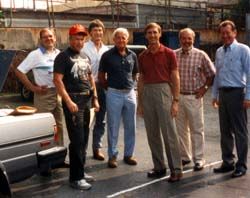 Lyle’s release from prison. Six of his fellow pilots came from around the country to support him. L-R, Colie Smith, Gainesville, GA, Lyle, Mike Phillips, Cumming, GA, Vic Manussier, Auburn, AL, Bill Rataczak, South Haven, MN, Dayle Yates, Cumming, GA, and Glenn Eggert, Scottsdale, AZ. |
I had 28 days of very intense in-patient treatment, then I asked to go through anadditional 30 days in a facility co-located to the one I was in where, it was said,treatment was more advanced and intense. It was difficult for me to conceive of moreintensity than I’d just experienced, but I wanted to build as strong a foundation aspossible in light of what was going to happen to me. By this time, the media had longsince had the story, I’d learned of legal consequences that were totally unknown andunanticipated at the time I entered treatment, and I knew prison was going to bemandatory. Intellectually, I had learned as much as there was to learn about the disease,the complexity of it, what recovery was and the process that worked, but there is anabsorption process that occurs from just being immersed in the midst of treatment and ittranscends knowledge and intellect. I knew that; I had sensed it and felt it, and I wantedto build an inner strength for the difficulties I knew lay ahead. I was about to walkthrough an exercise in sheer horror, pain, and humiliation that would be watched by thepublic and I wanted to deal with it as honorably as I could, and with whatever dignity Godsaw fit to allow me to retain.
I was sentenced to 16 months in prison and my two codefendants received 12. I had beenthe captain and I accepted it as fair. They opted to remain free for a year while legalbattles and appeals made their way through the courts. I chose to go in immediately andget it behind me. I served 424 days in our federal prison system as inmate 04478-041. Idon’t talk about that much because it has little, if anything, to do with my recovery …but my recovery has everything to do with how I handled my prison experience. I usuallyjust say ‘There are two groups of really sick people in prison, and the sickest group goeshome every night’ and leave it at that.
When did you give thought to trying to fly again?
I had a meditation book and it said ‘Before any dream can come true there must first bea dream.’ It was a couple of years before I began to dream about flying again. But part ofrecovery is learning to live life on life’s terms, so I had to be careful not to buildunrealistic expectations. I had lost my FAA medical certificate automatically because ofmy diagnosis of alcoholism, which was appropriate. And the FAA had done something theyrarely do and issued an emergency revocation of my licenses, which was also appropriate.So I’m without a medical or any licenses and I’m the most notorious pariah in aviation.
Judge Rosenbaum had some very strong feelings about this offense which were obviousduring the trial. And I don’t blame him. It was a betrayal of the public trust. Today,he’s one of the strongest supporters I’ve got. In fact he has urged me to make the attemptfor a Presidential pardon and has written an affadavit on my behalf that’s personal andvery moving. He had put sanctions on me that made it impossible for me to even think aboutgetting my licenses back. I had a lawyer who believed in me and worked three years aftermy conviction, refusing to take a cent from me. I had nothing to give him anyway, but hesteadfastly said ‘I believe in you and I will stay in this until the end, wherever thatmay be.’ We joke a lot about lawyers but no one I’ve ever met ever had a lawyer like Ihad.
I had been doing some good things, not with the intention of getting my job back, justbecause it was the next right thing that needed to be done. So my lawyer went back to thejudge and asked if the sanctions could be removed. The judge knew about some of the thingsI had done, but he told my attorney he wanted to hear directly from me. So I wrote anopen, naked letter which was 11 pages long and asked my attorney to edit it and boil itdown to three or four pages. When my lawyer read it he told me to send it as it was, notto change a thing. I still thought it should be shortened but I had learned to trust thisman so I sent it the way it was. Later, a Minneapolis TV station interviewed this toughfederal judge, and he said he had sat at his desk weeping as he read my letter. I hadwritten it from the heart but never expected it to have that kind of impact. The judgelifted the sanctions against me. That was just one of the miracles that happened. Liftingthe sanctions didn’t make anything easy, it just solved one impossible so I could tacklethe other impossibles.
And the next impossible was the FAA?
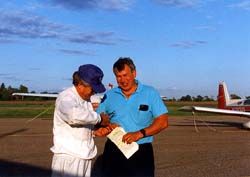 Northwest Captain Denny O’Connell gives Lyle’s shirt the snip treatment after he "solos" at Terry Marsh’s FBO in Buffalo, MN, 6/4/93. Denny died of cancer in 1997. |
Since I’d held an ATP my hope and expectation was that the FAA would require me toreattain the ATP, which was no small feat by itself. Instead the FAA said that if I wantedto fly again I would have to start with a private license, which I had never had. When Igot out of the Marines I took a quiz and they handed me a commercial license with aninstrument rating. Now I was going to have to get licenses I’d never before had and I wasgoing to have to do it in little planes I’d never before flown. It occurred to me that theFAA was setting the bar so high as to be impossible and that I would take one look andsimply quit.
I hadn’t thought it would be possible to even get my medical certificate back due to mynotoriety and the seriousness of what I had done. With FAA encouragement and monitoring,those alcoholic pilots in the airlines reattain their medical certificates in four to sixmonths; it took me two years and four months and included such extremes as smuggling myurine out of prison as proof of sobriety. A doctor I’d been on treatment with came to theprison once a month and did that for me. It was risky for both of us and I’d have gone tothe hole if I’d been caught.
When the FAA says ‘I’m here to help you’ most of us go the other direction as fast aswe can. Dr. Bart Pakull, head of the FAA program that deals with alcoholic pilots, couldnot have been more compassionate and understanding. After prison, I met him in person,looked him in the eye, answered his questions, and he was a huge help. He truly does wantto see recovering people returned to the cockpit. I have come to know him well over theyears.
After prison I returned to the hospital that had treated me and saved my life. I stayedthere over a year and a half working full-time with alcoholics and addicts. I had no legalrequirement to do that but I felt I owed a huge debt and wanted to do something to try torepay part of it. Making $6.75 an hour I knew I could never afford to do the flyingrequired to get my licenses — after I’d passed all the writtens. Barbara offerred to sellall our furniture to help pay for the flying but another miracle came along in the personof Terry Marsh, Northwest captain and friend, who had an FBO I never knew about. Terrytold me to come up and fly at his FBO free, that he wanted to see me get those licensesback.
I got permission from the Corrections people to go to Minnesota and stayed with Terryand his family for 44 days in the summer of ’93. You may recall that was the summer ofmonsoon rains and flooding throughout the United States. I sat out 14 rainy days but spentthem studying at the airport eight or ten hours each day I couldn’t fly. I flew 78 hoursin the remaining 30 days and got four licenses, two of them in one day. There were noshortcuts along the way; I worked over 2,000 problems, questions and excercises as I tookand passed the writtens. The FAA examiner, Mr. Bill Mavencamp, told me later the FAA hadsaid ‘don’t make it easy for him’ but he was as fair as was tough and he became a friendas we flew together.
How did you get back to Northwest?
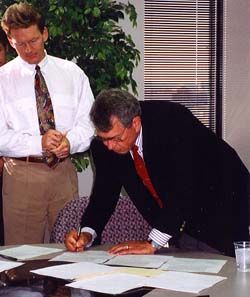 Capt. O.C. Miller watches as Lyle signs his back to work agreement; 11/1/93 |
Captain O.C. Miller [head of the Northwest Airlines’ pilot’s union] had been a noddingacquaintance at the time of my incident but he became a friend and began working to get meback. Northwest Airlines’ CEO John Dasburg had immense respect for O. C. but I neverreally believed I had a chance of actually returning. O.C. told me never to ask about theprogress and I said okay. Several years passed before I finally got a phone call from O.C.around 6 at night after I’d come in from a long day at work. I sat in my office at homeand listened as O.C. told me about the many disappointments and disillusionments he’dencountered in his efforts to change things and make a difference. I knew he was about totell me it was over, that this was one more thing he’d been unable to do. An inner voicewas slowly muting O.C.’s as I heard myself saying ‘This is about acceptance once again,it’s about accepting the final outcome and the way things simply are.’
Suddenly, I heard him say ‘Sometimes good things happen, though, and this is the bestphone call I’ve ever made because three hours ago you became a Northwest pilot again.’ Itwas a moment of huge emotional impact. Unable to speak, I walked back into the house wheremy wife was waiting, aware of who I was talking with and what it was about. Tears werestreaming down my cheeks and she feared the worst. She stood up and I hugged her, puttingmy face in her neck and managing to say "We’re going back," and I could speak nomore.
I wasn’t supposed to be a Captain again, which would have been a blow to a lot of guys,but I was so overwhelmed by being reinstated and being able to fly again that I didn’teven care. Then just prior to my final year at Northwest I was speaking for the third timeat the United Airlines flight operations annual workshop on substance abuse. I had toldthem that night ‘I’ll never get to be a Captain again but that’s okay. I’ve been there,I’ve done it, there will never be any unanswered questions and I’m grateful just to beflying again.’
I went back to my hotel and got another call from Miller, who was no longer head of theunion, telling me that Dasburg had changed his mind and that I would be a Captain again. Ithought I’d experienced all the miracles possible but I got to close my career and myfinal year as a 747 Captain. Captain Terry Marsh gave me my final type rating in a 747 andit was indeed very, very special for me.
When did you get your Warrior and what kind of flying do you do with it?
One evening during my flight training I was on the ramp at Terry’s flight school atBuffalo, Minnesota. It was about five o’clock and everyone had gone home and the sun wasjust starting to set. One of the Captains had a Grumman Tiger out there for an annualinspection. I spent about an hour just sitting on the wing and walking around lookinginside and wondering what it would be like to own my own airplane. I could barely imagineflying for the airlines again, and the thought of being able to get in my own airplane andgo somewhere was like the sixth dimension. We had been wiped out financially, totallyzeroed out when all this first hit. After we returned to Northwest we began all over.
Barbara and I talked and we clearly knew that we’d never recover anything close to whatwe’d lost … so we decided not to even try. Sure, we’d max the 401K and do what wasreasonable and prudent but we were not going to devote all our time and energy to thepursuit of material reacquisition. We had both learned how to live one day at a time. Itold her of my evening on the ramp alone as the sun set on a small airport and of my dreamto own a small plane, and she said okay.
Eventually I found the Warrior I now have and I can’t tell you how much I love flyingit. Barbara and I have been given back so much. We do what we can, in turn, to give back.We give away much of our earnings and have since the day we returned, and I like using theairplane to fly missions for Angel Flight, for those sick people who cannot affordcommercial transportation. I fly as many of them as I can afford but we pick up all thecosts ourselves and it can add up quickly.
Last year I spoke 22 times around the country. While I don’t really enjoy the speaking,I consider it an obligation and a debt I will never be able to repay, so I never say nowhen asked. From time to time I’m offered speaking fees and honorariums and I donate allthose back to a treatment center that works with Indian people who are struggling to getsober.
I have learned to be grateful for an experience that began in horror and shame; forsomething that put me near the edge of death as I thought about suicide in those dark andlonely days. If I could give the most precious gift of all to those I love most, it wouldbe the experience we’ve had with so many wonderful and loving friends who stayed thecourse with us, who never turned their backs and who believed in us so deeply. In thewords of Lou Gherig, "Today, I consider myself the luckiest man on the face of theearth."