






























As the America West Boeing 737 made its lazy finalapproach into Phoenix Sky Harbor International Airport, I wondered to myselfhow I was going to be able to make a fair evaluation of a two-person kit-builthelicopter when almost all of my rotary wing flying time had been accumulatedin large, military, jet-powered machines: HH-1Hs and HH-3Es plus a smatteringof experience in OH-58s and its civilian cousin, the Bell Jet Ranger. Outof curiosity, I had gotten myself checked out in a similar-size productionhelicopter (guess which?)…and frankly I was not overly impressed.Nevertheless, here I was in Phoenix to visit the RotorWay helicopter factoryin neighboring Chandler, Arizona, with the assigned task of making a fairevaluation of the new RotorWay 162F helicopter. In the name of objectivejournalism, I just made up my mind to ignore any preconceived prejudicesthat I may have brought with me and simply make the fairest evaluation thatI possibly could.
 The editorial staff at AVweb had decided that the time had come toexpand our coverage of experimental aircraft area, one of the fastest growingsegments of the newly-revitalized general aviation industry. What betterway than to go out and do a series of review flights on some of the morepopular kit-builts available on the market today. RotorWay was selected ratherserendipitously: at Oshkosh ’96, the RotorWay exhibit tent was right nextthe Cessna Pilots Association tent, which wound up being AVweb’s baseof operations at the fly-in. Naturally, we got to talking to the RotorWayfolks, the subject of our plans came up, and we were immediately invitedto visit Chandler.
As it happened, the only person with any rotary wing experience on theAVweb staff was me. So there I was, 1500+ hours of USAF Air Rescueexperience, headed to Arizona to try to find out what this homebuilt rotarywing phenomenon was all about.
RotorWay Headquarters
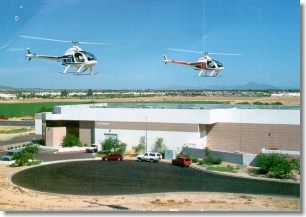 As my taxicab pulled up to the RotorWayfactory I guess was little surprised to find it to be such an ultra-new andmodern facility. For some reason I had imagined that a “homebuilt” factorywould be much less impressive than, say, the Piper plant that I had visitedonce. I imagined wrong. RotorWay’s 37,000 sq. ft. facility houses all ofthe company’s manufacturing, sales and training conveniently under one largeroof. While not as large as Piper’s plant, it was every bit as “for real”as any I had ever seen. It even has its own in-house flight trainingdepartment-complete with helipads-so that new RotorWay owners can get upto speed and checked out in rotary-winged flight and the operation andmaintenance of their new helicopter right here under the watchful of RotorWay’sown professional staff of in-house instructors and inspectors. (Tuition forthis in-depth training program is a $3,500.00 option.)
My guided tour of the complex was conducted by Suzy Bell, RotorWay’s publicrelations specialist, and RotorWay general manager Brent Marshall. Theirpride in their new facility was both obvious and justified. I found thefacilities neat, orderly and spotless, with hallways lined with framed picturesof RotorWay owners standing proudly next to their completed flying machines.The whole atmosphere speaks very clearly to the concept of a company thattakes their position as an aircraft manufacturer very seriously.
I had the impression that kit aircraft manufacturers obtained most of theircomponents and subassemblies from multiple outside subcontractors, and thattheir primary function was simply to make sure that all of the right pieceswere included in each kit. Wrong again! I was really surprised to find outthat every part of the RotorWay kit was manufactured right on site, eventhe rotor blades and the engine.
My background includes some experience in quality management systems, sonaturally I asked Brent Marshall to see what methods RotorWay had implementedto accomplish this critically important function. I was gratified to learnthat the company had long ago implemented a fully-functional QC program completewith well-documented standards and managers with clearly-drawn lines of authorityand responsibility. I was getting more and more impressed by the minute.
High-Tech Powerplant
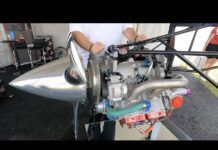
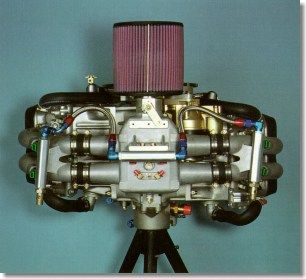 I was also struck by the technologythat went in to these helicopters. One of the more remarkable elements ofthis entire package is the electronic engine control and monitoring systemwhich RotorWay developed itself. They call it a FADEC, an acronym for “FullyAutomated Digital Electronic Control.” The latest RotorWay model 162F utilizesthe latest in fuel injection, electronic ignition and computer monitoring.The FADEC processing unit provides the RotorWay-built powerplant with thecorrect fuel/air ratio for optimum performance and fuel economy. In addition,this remarkable system lets the pilot monitor all vital engine performanceparameters via warning lights and a cockpit-mounted digital display. Itincorporates extensive operational redundancy: even in the event of totalfailure of the electronic control unit, a backup system engages automaticallyfor uninterrupted operation. This is the sort of technology you’d expectto find in just a handful of advanced military and transport aircraft, andfrankly I was amazed to find it being used on a two-place piston-poweredkit-built helicopter.
Preflight
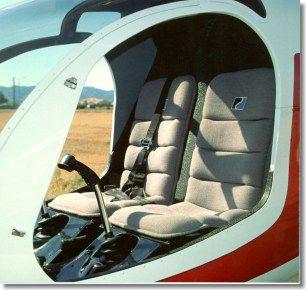 It was now time for the flight test itself. As I walkedout to the helicopter with senior RotorWay instructor John O’Neil, who wasto be my designated airborne escort for this flight, I couldn’t help butwonder about whether this diminutive craft could accomdate the two of uscomfortably, especially given that my beam is a bit broader than it was inmy Air Force flying days.
Once again I was pleasantly surprised. As I climbed into the into the 162F,I found that there was more than ample room available for comfortable ingressand egress, with or without the doors attached, and the visibility wasoutstanding. RotorWay claims that their cabin can comfortably fit pilotsup to six-foot-four, and from what I saw, I don’t have any trouble believingit.
The walk-around inspection wasstraightforward, with no unusual quirks or surprises. I was comforted bythe fact that most of the rotor hub assembly was easily visible for thoroughinspection (any of you rotary-wing types will know what I mean if you’veever flown a machine where the rotorhead was inaccessible or shrouded fromconvenient inspection. (Any H3 drivers out there?)
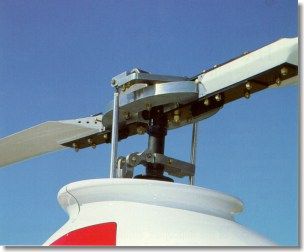 I followed along as John went through the starting checklist, and beforelong we were ready to take to the air. The first thing that I noticed asthe quiet 162F powerplant came to life and the rotor clutch was engaged wasthat the vibration level was as smooth as any two-bladed helicopter I hadever flown. I assume that the elastomeric bearing design of the rotor hubmust have something to do with this.
Let’s Fly!
Ah, but how will it fly? That answer was forthcoming very quickly as I tookthe controls and lifted the 162F to a three-foot hover. I honestly couldn’thelp thinking that this little machine had the feel, stability and controlresponse of a much larger helicopter. With the standard design of itsconveniently-located cyclic control stick, I found the RotorWay Exec 162Fto be a total dream to handle in the hover, through the transition, and incruising flight.
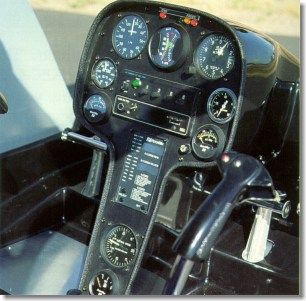 We did the normal cross-sectionof hovering maneuvers, turns and ground track exercises, all of which wereaccomplished with normal and straightforward control inputs. This is asurprisingly stable machine to hover, and exhibits no unfriendly tendenciesat all. There was plenty of power available in the climb, even with twofull-sized adults on board. The published rate of climb of 1000 FPM was notat all difficult to achieve at 26” MP, and normal cruise settled down rightaround 95 mph as advertised. The typical two-per-rev vibration-common tosome extent in all two bladed rotor systems-was very well-mannered in the162F and, quite frankly, barely noticeable.
In addition, I really liked the way it stayed in trim throughout the flightand did not require any unusual control inputs to urge it to remain so allthe way up to and including its maximum published top speed of 115 MPH. Steepturns in either direction required no unusual control inputs and were smooththroughout. And I was really impressed with the way that the RotorWay designwas able to combine big helicopter control feel with small helicoptermaneuverability and agility. This is really a fun machine to strapon.
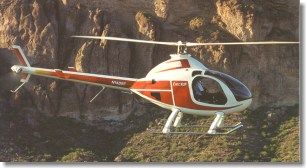 Not much to say about the autorotationexcept to watch your left hand when you lower the collective. The amountof clearance between your hand and the bottom of the door frame is a littletight so you need to be a little careful to avoid a skinned knuckle, butthe ship handled very nicely throughout the approach and flare. The powerrecovery (highly recommended for all of the obvious reasons, even for youformer Army types) was easy to manage and presented no directional controlchallenges to speak of. Just remember to stay ahead of the maneuver (as inany helicopter) and you’ll be OK, as long as you don’t let your rotor speedget too low. As with all lightweight helicopters, the 162F has a low inertiarotor system, and is a little unforgiving of pilot neglect in this very criticalarea.
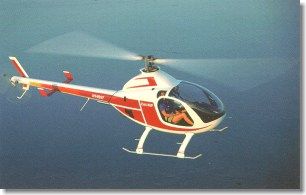
I’m pleased to say that my overall evaluation of the 162F was very positive.It is a very beautiful design that is combined with some truly outstandingsystems and components that would be hard for many production helicoptersto match.
Can I Build It?
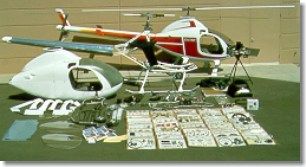 But what about us all-thumbs,mechanically-challenged types that would love to build and fly our ownhelicopter, but find it a major challenge to replace a hinge on a bathroomdoor? Well, it appears that the folks at RotorWay thought of us as well whenputting their program together. Along with each neatly bubble wrapped, cardedand clearly indexed (mostly pre-fabricated) parts delivery package, you geta beautifully-done, professionally-produced video tape showing you everytrick and detail involved in that particular phase ofconstruction.
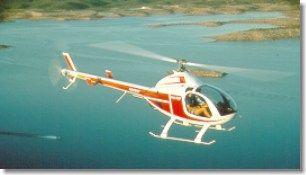 In addition, most of the hard stuffis already done for you at the factory. This includes all of the welding,which is factory-performed to quality-controlled production standards, amajor safety advantage in my judgement. RotorWay claims that the entire buildprocess for the 162F kit should take a homebuilder “with average constructionskills” (whatever that means) about 300 hours. This translates to about 7.5weeks if you were to work on it on a full-time basis (40 hours per week),which means that building this kit doesn’t have to become a lifelong ordeal.
For all of us wannabe helicopter owners with limited budgets, the RotorWayExec 162F could be the answer to our dreams. Financing of the $60,850 kitis available through Greentree, and that price includes everything exceptpaint, avionics and training.
A full-color information package on the 162F is available from RotorWay for$15.00, and a video is also available for $15.00. (You can get both for$25.00. Add an extra $5.00 for overseas shipping.) You can order by email,and they take MasterCard and VISA.
If you would like to get in touch with the RotorWay folks in Chandler, here’show:
RotorWay International
4140 Mercury Way
Chandler, Arizona 85226
Phone: (602) 961-1001
FAX: (602) 961-1514
Email: [email protected]
WWW: http://www.rotorway.com
Editor’s Note We’ve posted the complete specs for the RotorWay Exec 162F online. Click here to view them. |