




















If you don’t want to fly around thunderstorms in Floridain the summer months, don’t fly. But I got more than I bargained for inmy most recent flight from Lancaster, Pennsylvania to home base in BocaRaton Florida.
Friday, June 13, 1997
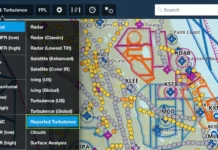
 Theusual clusters of storms over the Southern Florida peninsula were evidentboth on the radar picture I got with my weather briefing, my eyes in thecockpit and on the color radar in my Aerostar 601P, N6069N. There was onebig storm over Daytona Beach which was easily circumnavigated by goingabout 5 miles west of the OMN VOR and then turning to intercept V3 southbound.Ahead looked more ominous. There was a line of storms starting about Melbourne,Florida that looked, at least to the eyes, solid. ATC suggested headingsoutheast where “everyone else” was going through. After consulting theradar and the WX-8 stormscope I headed about 120 degrees, about 30 degreeseast of the normal V3 routing.
Thecells stood out very well on the radar as large red blobs; there was onover land near Melbourne and one well out to sea, with very little precipitationin between. The cells were separated by about 50 miles, and it looked likea good plan. I began my descent from FL220 to 16000 feet about oppositeMelbourne and soon entered the clouds. There were one or two small patchesof level 1 (light) precipitation showing on the radar and there was somemoderate turbulence as I flew through them.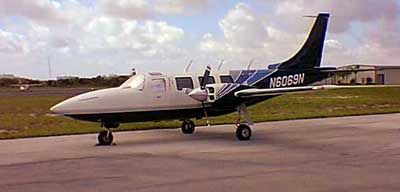 Each of these little areaswas about 2 miles wide with light rain on the windshield. Somewhere inthe continued descent I saw a lightning bolt off the left wing, at thesame time I heard a “whoooosh” – nothing else. The avionics never wavered,no circuit breakers popped, in short nothing happened. I estimated thelightning bolt to be about 1 mile away. I was more occupied with flyingthe airplane in occasional moderate turbulence and studying the radar thanthinking about a lightning bolt that I thought was more than a mile away.
About this time ATC suggested a turn back toward the airway. I declinedbased on the radar and flew another 10 miles before turning back towardsthe coast. After the turn, the clouds broke up and it was VFR the restof the way to Boca.
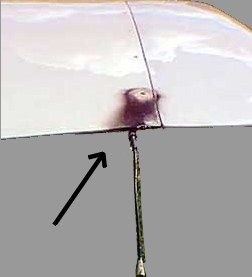
Onthe ground I noticed that one corner of the left propeller looked chipped.A close inspection revealed a jagged break of about ¼ inch and thealuminum looked like it had melted where the piece broke off. 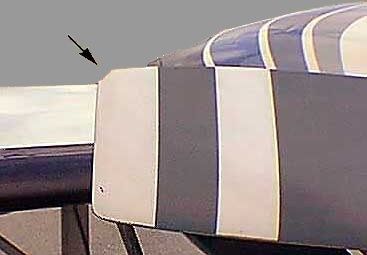 There wasa slight discoloring of the paint and I immediately thought that it hadbeen hit by lightning. I walked around the left wing and saw the threepencil sized holes in the trailing edge of the flap. There was a slightdiscoloration in the paint here as well. Continuing around the tail appearedto be undamaged, nothing on the flap on the right wing….then I saw thelarge, fist sized burn on the top of the right wing outer panel near thetrailing edge. The screw in that area had been melted and a small pieceof melted aluminum was also visible near the trailing edge.
The airplane had flown perfectly, with no hint of any problems all theway to BCT. The avionics appear to be undamaged. The burn mark on the rightwing was about 12 inches from the fuel tank in that wing which certainlymakes me nervous and I guess makes me lucky- if anyone hit by lightningcan be called lucky.
Monday June 16, 1997
What Now?
Thereare several service bulletins relating to what you have to do to engines,propellers and the airframe in the event of a lightning strike. Some, butnot all of these are to protect the manufacturers against any liabilityfrom subsequent failures.So far this is clear:
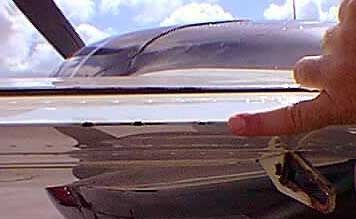 The left flap skin has to be repaired.
The right wing outer panel has to be inspected and repaired.
The left prop hub has to be taken apart and inspected.
The left prop blade that was struck may have to be replaced.
The wing structure must be thoroughly borescoped for internal damage causedby arcing.
The left engine must be torn down, inspected and demagnetized.
All the avionics must be checked for proper operation.
Tuesday June 17, 1997
More damage was found on the clear plastic cover to the wingtip strobeand recognition light. One screw was burned and the washers all showedsome heat damage. There was a small burn mark inside the plastic lens aswell. No other external damage has been found.
Palm Beach Propeller shop examined the left engine with a gaussmeterand found that it has a significant amount of magnetism. The right engineshowed none and this adds to the belief that it escaped any consequencesof the strike.
Lycoming issued a service bulletin for lightning strikes on June 30,1976. Here is the text of that bulletin:
Lycoming Service Bulletin Number 401The new flap skin is scheduled to arrive tomorrow.Date: June 30, 1976
Subject: Recommendations for aircraft struck by Lightning
Models affected: All aircraft powered by Avco Lycomingengines
Time of compliance: Anytime aircraft is struck by lightningDamage to an aircraft, which has been struck by lightning, is usuallyapparent and often confined to a specific area of the structure. In suchinstances where the engine and its accessories, controls, fuel or exhaustsystems are involved it is necessary to evaluate and repair the damagebefore the aircraft is flown again.
Although the path of the lightning may appear to have been aroundthe external housings of the engine components, it is nevertheless impossibleto asses the internal damage that might have occurred by heat during thelightning discharge. Therefor, in the event the engine has been damagedby lightning, disassemble and inspect the component parts. Heat generatedby the arcing effect of the electrical discharge can cause irreparabledamage to the hardened surfaces of ball bearings, crankshaft bearing surfaces,camshaft lobes, gear teeth and other parts that are surface hardened; theseshould not be reused if discoloration, cracks or other indication of damageby lightning is evident.
I’ll continue to update this as it happens.
