









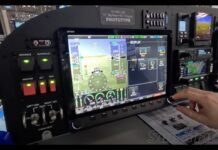




 Small children have vivid imaginations. They create imaginary playmates and re-enact stories, movies, etc. Unfortunately, as we grow older we tend to lose the ability to apply imagination to our activities. In training instrument students I explain the three skills required of an instrument pilot – instrument cross-check (scanning), instrument interpretation (what are these gages telling me?) and, finally, aircraft control about the three axes through which the flying machine can move. I then try to get the student to imagine him/herself as a computer and the panel a programmer, feeding information into the computer during the scanning stage. Then I ask him or her to imagine that the roles are reversed, as the pilot becomes the programmer, making inputs into the panel through yoke, rudder, throttle and trim by means of which he/she controls the aircraft. If the student has the ability to apply imagination to his/her activity, this technique works very well and keeping the airplane upright without visual reference to the horizon becomes easy. By means of pitch, bank, power and trim the pilot causes the airplane to do what he or she wants it to do and go where he or she wants it to go.
Open Hood
One technique which I have found very helpful in training instrument students in approach procedures is to have the student fly a couple of approaches, both with radar vectors from an approach controller and the full approach – including the procedure turn – WITHOUT A VIEW-LIMITING DEVICE IN PLACE!
 This provides the student with the opportunity to see exactly what those lines on the chart are doing for him/her. He can see the controller putting him on a wide downwind, a far-out base, and a 30-degree cut to intercept the final, all the while adjusting his altitude so that he will be in a position to cross the final fix at the appropriate altitude. After this experience, when the pilot executes an approach in IMC or with a view-limiting device in place, he can apply his imagination as he follows the directions of the controller or follows the lines on the approach chart, and be fully aware of exactly where he is spatially and what is happening to him. Makes the whole experience more meaningful. I have found this to be a very valuable training technique. It works for me, and any instructors reading this, if you haven’t tried it, please do. Believe me, it works, and will make your job a whole lot easier.
Thinking Flying
Human beings are not designed for flight. A few furred mammals, most insects and most birds are designed by nature for flight. For these lucky creatures, flight is a natural activity. However, for us it is a highly unnatural activity. Although we can swim in the water, our natural environment is the land. And our natural means of transportation involves movement on the surface of the earth. We are designed to walk upon the earth, and we can swim through the water. But to fly through the air is an entirely different matter. The air, to us, is an unnatural environment, and to operate in this medium we must use a machine created and built by man.
 Pilots are gadget lovers what with GPS, Loran C, CRT displays, moving maps, flight directors, HUDs, etc. Still, the most important computer in the airplane is the one between the pilot’s ears, and the use to which this computer is put defines the degree of success of each flight. The human nervous system may be likened to a computer, having hardware (input-CPU-output-feedback systems) and software, which includes what the pilot is, knows, and is capable of doing. The input is received by all our senses – the visual system, the vestibular system and the somatosensory system (seat of the pants). Hearing is another vitally important sense as we are tuned to the slightest change in the noise of the engine(s) as it or they drone along. Any slight change in vibration that we feel or in the sounds we are hearing gets our immediate attention and produces an instant reaction.
Personal Experience…
 And on the subject of hearing, I frequently fly across Lake Erie in a single-engine airplane. I climb to a high enough altitude so that there is only a two or three minute period during which I cannot glide to land. As soon as I reach that point, the engine starts making the strangest noises. Somehow it seems to become rough. And when I have progressed far enough to glide to the far shore, it smooths right out. Happens every time. Weird, isn’t it? We even have a name for this phenomenon. It is called “automatic rough.”
I have a policy. I never tell anyone how to fly. I tell ’em what I do and why, and if they like that technique, they’re welcome to adopt it. When asked, “Why did you do so and so?” I frequently have to say, “I honestly don’t know. I just keep my mind on the objective – what it is that I want to accomplish, and then I do whatever I have to do to make it come out right at the end.” This system of keeping my eye on the objective works very well for me. And when I was a DPE (designated pilot examiner), I didn’t care what technique the applicant used just so long as the published objective of the practical test standards was met for the particular task at hand.
…Playing The Game…
 I’ve never tried it myself, but I know a very successful professional flight instructor who sits down his students in a straight-backed wooden chair and talks them through an imaginary flight, or rather has them talk him through it. This guy specializes in instrument training, and he plays controller while the student plays the role of a pilot on an instrument flight. They plan a trip on airways using a low level en route chart, and the instructor throws curves at the student (changes in the routing, holds, etc.). I believe this is a very valid approach to the problem, for the really difficult part of learning to fly on the gages is not manipulating the airplane in IMC, but learning to live in the system. After all, when the weather is really grim and you can’t even see your own wingtips, there’s nobody up there but the pros, the guys who earn their living by shoving tons of aluminum around in the sky, and they know what they’re doing. If the lowly general aviation pilot wants to play in that ballpark, he or she had better know what he/she is doing as well. I have always maintained that the difficult part of learning to fly on instruments is not keeping the airplane upright (there was a time when this wasn’t true, but now it is infinitely easier to control the airplane without visual reference to the horizon), but rather learning to live in the system. (Also passing the knowledge exam – I have seen numerous bright guys bust that one!)
…Staying Ahead…
 The most important single attribute a pilot can have is the ability to be mentally far out in front of the airplane, and that may not be easy in a machine that is traveling at a speed in excess of two miles per minute. Rod Machado advocates a policy of always thinking of the next two things you are going to do as you charge along through the sky, and this is an excellent rule to follow. When the weather is really grim, the turbulence is tossing you around, you have your hands full of airplane and some controller, sitting in a nice, dry room with no windows, is rattling off instructions, it’s no time to be playing “catch-up.” Of course, personally it is all I can do to stay one step ahead, let alone two. But then I’m not as sharp as most pilots. I’m just a tired old man who blunders around the sky and usually manages to reach his desired destination (and all in one piece without bending the metal or hurting anybody, including myself).
A pilot should always be anticipating what is coming up, yet be flexible enough to change course as new instructions are issued. And if you are thinking two steps ahead it is not difficult to change when ATC throws you a curve. Really, the key to every successful flight is that there should be no surprises. By anticipating what’s coming up you shouldn’t be surprised, and the flight should be successful. By the bye, this business of staying ahead of the airplane doesn’t begin and end with the takeoff and landing. It starts with the preflight and ends when the airplane is completely secured after landing. I firmly believe that the most important attribute a pilot can have is the ability to anticipate what is coming up next.
…Fear
1. Illness. Do I have any symptoms? |
It has been said that the penalty for having imagination is fear – that this is the price we pay for having and exercising an imagination. Remember, panic derived from fear is the killer in aviation. There is a narrow line between being bold and being afraid, each of which can result in disaster and, although fear is a killer, a healthy respect for the equipment, the weather, and one’s own ability is essential to the survival of an aviator. If you keep your cool there is almost nothing that can happen with or to the average general aviation airplane that is not only survivable, but that won’t result in little or no injury (and even little or no damage to the aircraft). Although I’d rather be lucky than skillful, I have supreme confidence in my ability to successfully handle almost any situation in which I find myself. Long ago I determined that I would “assume the risk” involved in aviation. All we can do is carefully analyze the options. Using the personal I’M S.A.F.E. checklist, obtaining and understanding a thorough weather briefing, and ascertaining that the aircraft is indeed airworthy will prepare the pilot for virtually anything he or she might encounter. Having done all this, and adding the factor of imagination, we are as prepared as can be to go forth and slay the dragon.
For good deals on great stuff, check out my web site.
Usual Boilerplate: If you have a comment regarding this column, please post it here rather than sending it to me by direct email. That way others may benefit from your input.