














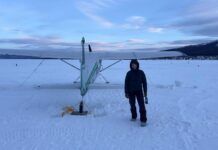








 After flying for a few years, many pilots come to feel that airports, just like airplanes, have personalities. Here in the Pilot’s Lounge at the virtual airport there seems to be a pretty universal opinion that while each airport is a gateway to the world aloft, some are warm, friendly haunts, as comfortable as an old shoe, while others seem cold and unwelcoming. The question as to what makes for a user-friendly airport came up earlier this month when a number of the regulars gathered at a real airport for our annual weekend of flying little airplanes on skis. We were in a most pleasant spot, in old, slightly tattered chairs, looking out of the bow window at a snowfall that was temporarily keeping us on the ground, while we felt the heat of the wood stove and talked of making the world safe for aviation.
A first-time visitor to our midst discovered he liked flying a Super Cub on skis and proved to be an interesting addition to the conversation. He had just been appointed to the airport commission at his home airport near a community of about 10,000 souls. We found he very much wants it to live up to its potential as a good place for people who like aviation. He informed us that while the area has a number of vacation homes and resorts for summer and winter sports, he doesn’t feel that the airport attracts nearly the activity it could. There are a few company airplanes based there and a fair number of privately owned machines used for business and pleasure, but no one that gives primary flight instruction regularly and little to really attract people to fly in to the airport itself. The county handles fuel sales so an FBO probably cannot be expected to survive on the airport. He sincerely wants to improve things and started the conversation going as to ways to make that happen.
Because all of us in the Lounge like airports, the discussion as to what constituted a user-friendly airport was lively, and, unusual for the Lounge, remarkably lacking in major disagreements. After our weekend discussion, I also posed the question on Avsig, the oldest, and probably the best, of the Internet aviation sites for the exchange of ideas. As usual, I got some good suggestions and heard strong opinions.
Size Matters
Airport size does matter. Where an airport is big enough to support one or more FBOs, the friendliness of the airport to the pilot flying in or prospective user driving in tends to be measured by the FBO one visits. I’ve reported on the good, bad and miserable at FBOs in this column before. Since then I’ve learned that some portion of the way an FBO behaves is due to the underlying political and economic climate created by the entity that controls the airport. At smaller airports the airport boards are the overwhelming factor in the friendliness (and ultimate success of the airport, because the two are intertwined).
Airports Aren’t Just One-Dimensional
Communities often treat their airports as nothing more than a necessary evil in the transportation system. The citizens and, sadly, the politicians, tend to think of them as little more than sprawling train stations, good only for moving people and things and generating paranoia about security. If they give much more thought to the subject some might say that the local airport is where the rich folks keep their dangerous little airplanes. Such a one-dimensional view of the airport hurts everyone in the community because it fails to recognize the airport for the asset it truly is. If the members of the board responsible for running the airport see the airport as only for transportation they fail to fulfill their responsibilities to the community in more ways than they realize. An airport serves more than the transportation needs of the town. The board members must remember that their individual obligation is, always and foremost, to the people of their community. Despite what they may be told, their responsibility is not just to generate money from the airport or keep its costs down. While the twin goals of making the airport pay for itself and serving the community members are generally compatible, they are not identical. The difference must never be forgotten. Serving the community means more than only trying to make the airport a generator of revenue.
Recreation and Education Are Community Values
In addition to being vital to the survival of any city or town as an essential link to our international transportation system, an airport serves needs for recreation and education. Of course it does. While we tend to think of the city or county commissioners only collecting tax money and spending it on roads, courthouses and other solemn sorts of things while worrying about liability out there at that dangerous airport, they are also obligated to provide the stuff that makes life more pleasant. That’s why the best towns have good parks, schools, hiking trails, art museums, bike lanes, marinas and even, dare we say it, airports. It’s absolutely accepted that parks, schools, bike lanes, museums and hiking trails are needed and that they don’t make money for the community. They, too, have liability exposure because kids regularly do swan dives from monkey bars, drunks fall into the Van Gogh and bikers find creative ways of wrapping themselves around trees, and then eagerly blame the gum-mint. People have been known to get hurt at airports; however, my experience is that in the average year far more people get hurt or killed (or criminally assaulted) in parks or on bike trails than on community airports. Yet, airport commissioners are constantly worried about airport liability. (If they’ve got a good city attorney he or she should bone up on the state’s governmental immunity statutes, they may be better for the community than is realized.) Just like the marina and the bike trails, the airport provides recreation to a substantial portion of our community. No one begrudges the community marina that serves those who like activities on and around the water. So should they support the airport because it serves those whose recreational activities involve being in or around aircraft as well as those who like to just be able to look out over an ordered, open space in an otherwise cluttered, hemmed-in world.
The “Friends of Meigs” organization has been trying to explain to the unhearing Daley machine in Chicago that Meigs Field is a beneficial part of the lovely park and museum campus on the Lake Michigan shoreline. Perhaps now that Meigs appears to have been saved, someone in that administration will catch on and make use of the potential of Meigs to serve the recreational needs of those who like the lakefront.
Airport commissions have found that, for a surprising number of people, recreation at the airport can be as basic as the place where folks can park their cars and watch airplanes. We’ve all seen the families having a picnic on a warm day at the observation area so the kids can see the airplanes. There is a also a growing number of hobbyists in this country that engage in “plane spotting.” It’s been around a long time in Britain and grew out of the train-spotting hobby from the 19th century. Just as in bird watching, enthusiasts keep records of the type of airplanes they have spotted; however, they also must record the tail number for it to count. Longer lists are, of course, better. There are web sites devoted to passing along information on airports that have good observation areas for plane spotting. Plane spotters may not burn avgas, but they sure buy auto fuel and food in the local community. (Yes, there was some weird paranoia in Greece recently when some innocent British plane spotters were arrested because they were hanging around airports and wearing binoculars. But, bird watchers have been accused of spying, too.)
I’ve learned that there are a certain number of people who are not pilots and not particularly interested in airplanes, who say that they experience spiritual renewal and general recharging of their emotional batteries by going to their local airport. For them, it is an open area of land that is peaceful and restful. It provides a perfect spot for them to meditate and reflect. When I ask them about the noise of the airplanes they comment that only a very few of the airplanes are noisy anymore and, anyway, at smaller airports there aren’t a lot of airplanes going by. For them, the observation area is far quieter and much less crowded than the downtown parks. Plus, they never worry about getting mugged.
I’ve got to admit I understand that point of view. For me, one of the most pleasant ways to get away from the pressures of everyday life is to simply go to the airport, even if I don’t go flying. Plus, I’ve certainly seen spiritual awakenings at far less pleasant places than an airport. A lot of pilots describe such spiritual experiences when they fly. Who is to say others can’t have them on the ground. It may be that airports have more good karma than any of us know.
People definitely go to airports to learn, just as they go to the adult education classes at the local high school. All of us who fly learned to do so at an airport, most of us just never made the connection to it as an educational institution.
It seems to me that an airport is much more than just a transportation site. I think that if I were on an airport board I think I’d try to add recreation and education to my thinking about the uses of the airport. It sure wouldn’t hurt to have people that like the place when I had to go to the county commission to argue for the airport budget.
Meeting Recreational Needs
So to begin, a basic need for an airport, no matter how big, is a spot where people can watch the airplanes. It needs good sight lines, some picnic tables, and maybe even a few grills so folks can bring their charcoal. If the fence is close enough to a taxiway so that kids can wave at the people in the airplanes and get a wave back, it’s a double bonus. The kids feel connected to what’s happening and are more likely to learn to fly (making money for the airport) or at least support it when population pressure leads to the inevitable “shut it down” cries. It’s a very inexpensive way to build support for the airport as a community asset. In this day and age I’m firmly of the opinion that airports need all the supporters they can get.
I’m reminded of Ford Airport at Grand Rapids, Michigan, where the observation area was so popular that a new one was an integral part of the design when a runway extension wiped out the old spot. And of Des Moines, where the much-loved place where people could park and watch airplanes was, decades ago, christened “the blue lights.” It was torn out recently due to poor planning and the uproar surprised the hide-bound characters in charge. I don’t know what is going to be done to replace the blue lights, but I’ve got a couple of nieces who are pretty upset that they and their mom no longer have a place to go watch airplanes. Erika and Erin, print this out and have Barb send it to the airport commission.
Encourage fly-ins and airshows so that the community is attracted to the airport. While I’ve not seen the data, it is widely accepted that airshows draw more people each summer than any other outdoor events. It’s a great way to get people out to the airport. Make sure that local operators are featured so anyone who decides it’s time to learn to fly can sign up then and there.
Provide a place for meetings at the airport. Encourage the Boy and Girl Scouts to meet at the airport and see about forming an Air Explorer Post. Encourage the CAP to hold its meetings at the airport and provide space for its disaster drills and arrange for it to have some public demonstrations of its often-impressive activities.
Use The Space
One thing most airports have is space. A little creative planning can make use of some of that space for community recreation needs, particularly those that have some connection to aviation. Put in rings for the control line model airplane folks to use. What better place for them? They certainly aren’t a security problem, they like airplanes. The Radio Control crowd might not be a good fit if the airport is busy, but if it’s pretty quiet, why not? Most of those folks are pretty responsible.
Space also means buffer zones for noise. If development hasn’t yet built up around your airport, start taking action now. A number of airports have municipal golf courses adjacent to them. Golf courses use up a great deal of space, and they mean that houses won’t be built on the airport boundary. While I respect a golfer’s need for quiet, the occasional airplane isn’t going to hurt anything. Anyway, I’ve always wondered why we can scream our lungs out at physically fit batter facing a baseball coming at him at 90 mph and we have to be dead silent while a 250 pound, red-faced guy with Dunlap disease tries to swat a stationary ball.
No matter how small the airport, the governing board can help make it user-friendly by keeping the noise away from residences. This means working early and often with the local zoning boards to make sure that the land around the airport is zoned for anything but residential use. That’s difficult because the airport was probably built on cheap land to start with and developers go for cheap land near airports the way sportscasters go for clichs. It’s a constant fight, but almost always the one that really matters in the long run.
Adequate Services
For a town to attract and keep decent-sized businesses it has to have an airport. Period. And that airport has to be able to handle airplanes that can move people, equipment and documents fast, when needed. That means at least one runway with accelerate-stop distance for twins (at least 4,000 feet at sea level) and a satisfactory instrument approach. That costs money. However, successful businesses know the time value of aviation. They will not locate in communities without an adequate airport. The employment generated by the mere existence of an adequate airport should justify its existence without question, the rest is gravy. However, politicians tend not to be well enough versed in economics to look at airports that way (or have already given huge tax breaks to the businesses) so many take an extremely short-sighted view and demand that the airport be self-sufficient, not realizing that for a small community, such a desire is counterproductive. They wind up limiting the resources of the airport so badly that they chase off the very businesses that would otherwise locate there and generate tax dollars. It’s sad when students who fail Econ 101 become politicians.
Attract The Fly-Ins
The lounge regulars then started listing other check off items: spotlessly clean restrooms; good signage to tell arriving pilots (day or night) where to park if there is not someone to direct them via Unicom or meet them and marshal them to a tiedown; tiedowns with ropes or chains; overnight hangar space; fuel available at least from dawn to dusk (self serve is not a bad idea, but not those gawd-awful machines that require dozens of entries and the patience of Job to use); maintenance available on the field with information on how to get it; in northern states access to a heated hangar or pre-heat and de-icing at a reasonable fee; good snow removal by a plow operator that doesn’t hem in tied down airplanes; a comfortable common room for pilots and passengers, with weather access (most wanted computer weather access) and coffee, although some said a machine that can make it one cup at a time.
Everyone wanted a restaurant on the field if at all possible. A good restaurant that attracts people to the airport does good things all the way around.
Convenient ground transportation is a must. Many folks said they wanted access to rental cars and they wanted to be able to drive onto the ramp to load and unload. Airport courtesy cars are wonderful things when and where they exist. I’ve also noticed that some smaller communities turn old police cars into the courtesy cars at the airport. I’ve used them and I think it’s a great idea.
Hire employees who are people-friendly. The best I have ever seen anytime, anywhere, were a few years ago when I made some trips into Elliot Lake, Ontario, Canada. They were employed by the government entity that runs the modest-sized airport, and were the most wonderful, helpful airport employees I’ve ever had the pleasure to meet. The last thing your airport needs is sullen people dealing with the public. If you have them, either get their attitudes turned around or assign them to stoplight repair or searching for leaks in subbasements of municipal buildings.
Hire an airport manager who supports the airport, is innovative and wants the airport to succeed. Too many are busy keeping their heads down, hoping the governing body won’t do anything bad. You want someone who will make the airport look good.
Train employees to use the Unicom correctly to provide wind and traffic information. It is a great help.
Make sure it is easy to find one’s way around the airport at night.
Local Airport Users
Try to have a good meeting room where the local EAA chapter can get together weekly or monthly. If the chapter wants to build a hangar, lease the land to it for a buck a year. It either will have, or can get, 501(c)(3) status with the IRS as a nonprofit, so eat the cost of the land lease because the activity the group will bring to the airport will more than offset the lease income in fuel sales.
For people who live in the area and want to fly, your airport may be only one of two or three from which they can choose. The Lounge faithful said that the environment for flight training and general aviation has to be positive for your airport to attract and keep student pilots (after all, they are the ones who become the renters and owners that help keep the airport alive). Encourage flight schools.
I don’t know how many people have told me about their airport and how it finally got a small flight school only to have the “jerks on the airport board” drive the flight school away. Airport boards that act in such a manner violate their duty to their communities. While they don’t have to tolerate incompetence, they have to understand that an operator has to make a living and they cannot hamstring the effort with foolish regulations, time-wasting demands and interference with the operator’s business.
The FARs do place some requirements on public airports that get federal funds when it comes to leasing space to operators. Most of those requirements boil down to giving everyone an equal opportunity while recognizing that economic realities may preclude more than one FBO on a little airport. When you get down to it, the success of an airport often depends on how the community sets up the leasing requirements for potential operators. Too often the airport authority establishes such unreasonable minimums as to equipment and services that an FBO must have, that they make it impossible for any smaller operators to get established, even if the airport could support more than one FBO. The sad part is that from time to time the operator that is given the lease is a relative or buddy of someone in the local power structure and responds with high prices and lousy service. The airport board then can’t figure out why there is so little activity at the airport when the community college down the road has a flight school bursting at the seams. So, support the little operator and encourage a tie-in with that college.
One solution is to allow leases to operators that are not full-service FBOs, especially if the airport is going to keep the fuel sales for itself. Allow an operator to just be a maintenance shop, or avionics repair facility or flight school, but don’t make each operator be all three. For airport board members in smaller communities: a full-service FBO is probably not going to plop itself down on your airport and solve all your problems. You are going to have to be flexible and not put in so many regulations that you prevent an operator from making a living. The operator may like aviation a lot, but he or she still has to eat.
Let people do maintenance in their hangars. Don’t get all knotted up because it might not look clean and neat when the hangar door is open. Your job is to serve the community, not be rigid and command that all hangar doors have to be shut all the time because it fits your image of how an airport should look.
Maintenance inside hangars certainly is not unsafe. Despite claims, it doesn’t hurt the operators on the field because those owners won’t go to the local operators for small stuff, anyway. If you let them work on their airplanes in their own hangars, the chances are better that they will buy parts from the local operators. (And go to the local mechanic when they realize the problem is larger than they thought.) Yes, you can require certain standards as to the condition of the hangar; it can’t be a fire hazard.
When you see people out at the airport on a Saturday, tweaking their airplanes or shining them up, you will also see people coming out to be with the airplane owners. When you have people at the airport they buy sodas, food and avgas. When you have people at the airport it engenders good feelings about that airport (unless they are muttering about the backwards airport board) and more people come out and buy sodas, food and fuel and make use of the airport for recreation. The airport becomes more popular. A popular airport finds that it’s easier to get money from the municipal coffers.
If possible, give a price break on fuel to hangar renters. Work to keep them happy. Maintain the hangars. Don’t prohibit reasonable improvements to the rental hangars such as winches and insulation. Be out there when the hangar renters are there and get to know them. Listen to what they need and their thoughts on airport improvements. It might actually happen that one of them will have a good idea.
Publicity
I just learned of a successful search for a lost child by a pilot in her Champ. She was smart enough to write it up and send it to the local media. All published the story and the airport and its users got some positive publicity.
If someone at your airport does something good with his or her airplane, such as a medical mercy flight, an aviation award or a successful search, get the word to your local media. When the CAP does a practice search and rescue and gets a good score, get the word out.
Get to know at least one print, radio and TV reporter in the area. Provide “background” information on aviation and what happens at the airport. Pass news information to those persons so you become the one they call when they have an aviation story and need assistance to get it right. They get the details correct with your help; they look good and keep calling you. You have a conduit to get out the good news stories related to the airport and, if something bad does happen at the airport, you are in a position to talk to reporters that know you and are far more likely to listen to your side of the story than descend on the airport with their minds made up against you.
Hangars
Hangars are in chronically short supply at virtually every airport. Airport authorities have a million reasons why they won’t build them, and, short of simply not having the space, almost none are valid. If the airport wants income, build and rent hangars as fast as you can, or set reasonable standards, lease the land and let private groups build hangars and rent or sell them. Every one of us who talked about this subject mentioned the long waiting list for hangars at their home airports and the incomprehensible refusal of the authorities to build hangars despite the demand.
Airport boards historically hurt themselves because they require that ownership of privately built hangars revert to the airport after 20 years. It’s a killer for business. Be reasonable, either substantially lengthen the time or let the ownership stay private and lease the land at a competitive rate based on the area. The airport can enforce rules regarding upkeep, appearance and what’s stored in the hangars whether or not the airport owns the hangars. Don’t do stupid things like ban self-fueling. We’re big kids. We can fuel our airplanes without hurting ourselves.
Business Aircraft Arrivals
Welcome corporate and charter flights, both passenger and freight, with open arms. Most of the people trips are heavy hitters coming in to visit your local businesses. Those passengers tend to be meeting with upper management of those businesses, so they will pass along how they were treated at your airport. If they get red carpet service, the businesses are going to hear about how great the local airport is. Get to know the top management of the local businesses and find out how you can best serve those who are flying in to visit, then do it. When you go to those same businesses to ask for their support for the next airport bond issue, you want them on your side.
Get in touch with a couple good, local motels that have work out facilities and see if they will provide “day rate” rooms to charter and corporate pilots who have to wait for their passengers. Many charter and corporate flight departments will spring for such rooms for their pilots. The motel can sell the same room twice in 24 hours and suddenly sees the airport as an income generator.
If it the Part 135 arrival is an on-demand Cessna 402 loaded with freight, make sure the truck meeting it can get to the airplane expeditiously. Do what you can to speed the transfer. The big boss at the local widget maker may not hear about it when you smooth the way for that roll of 2024 aluminum to get off the airplane and onto the truck so a shut-down assembly line starts running 90 seconds faster, but that big boss will for sure hear about it if that truck is held up for five minutes while your employee takes his time unlocking the gate onto the ramp. Paybacks for that sort of inconsiderate behavior can rock the very foundation of your airport.
Keep Being Creative
Everyone in aviation wants airports to thrive. There are few things quite as sad to a pilot as an airport with a big X in the center and grass growing through the cracks in the runways. Making the airport an efficient place for the business user, a pleasant experience for the fly-in visitor and a fun destination for the locals, goes a long way toward assuring its long-term survival and recognition as a valued part of the community for every member.
See you next month.