













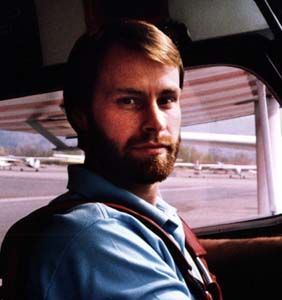
Rich Stowell was born December 24,1957, in Newton, N. J. He grew up near Sussex, N. J., watching his neighbors LeoLoudenslager, Betty Stewart and other aerobatic champions performing theirairshow routines. He wanted to fly and took enough instruction to solo. Hisparents didn’t exactly disapprove, but they vectored Rich back onto a moretraditional career path. He got a degree in mechanical engineering and a jobdesigning ventilation systems for office buildings. For two years he worked inan office three floors underground on Park Avenue in New York City, then he sawthe light. He took that job and shoved it all the way to Florida, where he flewevery day until he had a private certificate. That was just the beginning.
Rich went back to New Jersey for aerobatic training, which was always part ofhis plan. Eventually his job – which he kept strictly to support his flyinghabit – shoved back, sending him to Los Angeles, which allowed weekend visitsto nearby Santa Paula, Calif., where he now teaches. In the late ’80s Richdeveloped a syllabus for an aerobatic instruction program, which has evolvedinto the Emergency Maneuver Training – EMT – program. EMT teaches pilotshow to handle unusual attitudes, stall/spin conditions and emergency andloss-of-control conditions. Working out of CP Aviation in Santa Paula, Richstays booked year-round with students from all over the U.S., Japan and Europe.Rich has written two flight training books and has produced and hosted threeeducational flight training videos. He’s a regular contributor to FlightTraining magazine and has lectured at AirVenture Oshkosh and Sun N Fun.
How did you discover flying?
I grew up in northwest New Jersey, and usually when I say that people thinkabout Philadelphia and New York City. But northwest New Jersey is full ofrolling hills and trees and countryside, and Sussex airport is the localairport. When I was a teenager, LeoLoudenslager was based there with his Lazer. Because he was an icon inaerobatics, he’d attract a lot of the other popular acts and we had a great airshow at this little podunk airport in New Jersey. We had folks like JimmyFranklin, and the French Connection, who were based in New York state. We alsohad a lot of airline pilots who lived around the Sparta, New Jersey area, and asa teenager all of this had quite an impression on me. I hoped that someday Icould do something in aviation.
My parents were fairly conservative so I was expected to finish school andget on a career path before doing anything with aviation. And that’s what I did.But about two years into my career, working three floors underground on ParkAvenue in New York City, commuting to Manhattan 60 miles each way, never seeingthe light of day, in a room with 200 drafting tables, designing heating,ventilation and air conditioning systems for office buildings, I decided it wastime to learn how to fly.
I took my initial lessons at Sussex airport in a Cherokee 140. I got throughmy initial solo there, but then work dragged me away from flying, and I was awayfrom it for about two years after soloing. Finally it got to the point where Ididn’t want the corporate life, so I quit my job. My parents were living inPompano Beach at the time. So I moved in with them, drove to Tamiami airportevery day, and flew every day until I got my license. Ground school in themorning and flying in the afternoon.
Then I moved back to New Jersey to begin aerobatic training. That was reallymy goal. Most pilots can recall their solo as a huge event. I actually had twosolos, one in New Jersey and one in Florida some time later. But those solosdon’t stand out in my mind because my ultimate goal was to get into aerobatics.I found a Decathlon to rent at Caldwell airport, and was training with arelatively new – at the time – aerobatic instructor named DianeHakala. She would later go on to become the second woman U.S. NationalAerobatic Champion, after Patty Wagstaff.I don’t think I could have had a better introduction to the world of aerobaticflying.
What brought you to California?
I got a job offer in L.A. I really wanted to fly as much as possible and Ithought the California weather would give me more opportunity to do that. So Ilived near Santa Monica airport, worked in L.A. and would come to Santa Paula onweekends to fly. When I was in New Jersey packing to move to California I founda stack of FLYING magazines, and the issue on the top of the stack had a coverstory about Santa Paula airport. So I knew that was a place I wanted to visitwhen I got out here. I fell in love with it, and started flying here regularly.
I flew my first aerobatic competition in Paso Robles in a Decathlon. At thetime the InternationalAerobatic Club didn’t have a Basic category in aerobatic competition.Sportsman was the entry level. But even at the Sportsman category you’recompeting with airline pilots and fighter pilots and Pitts pilots and here I amwith my Decathlon and about 100 hours and my knees knocking. I was scared todeath. I remember sitting in the airplane and the Starter telling me to fire itup, and I couldn’t even remember how to start the airplane. But I got throughthe three flights, and I didn’t come in last! I finished 11th out of 13, and,getting back to soloing, that contest is what I vividly remember as my firstreal solo. After that I competed in contests at Delano, Taft, and BorregoSprings, and just being around the competitions and the pilots taught me a lotabout flying.
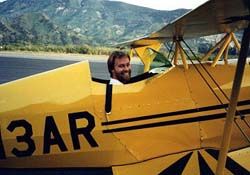 Flying is the Pitts! Flying is the Pitts! |
When did you begin teaching?
In 1987 the school I was renting the Decathlon from was bought out by ClayPhelps, who then started CP Aviation.We had known one another and we were about the same age. Clay was born andraised on the field, and the building we’re in was the original FBO started byClay’s father back in the ’30s. The previous flight school, though, had noformal aerobatic training program. Of course there were plenty of ‘aerobaticlessons’ being given, but not a formal system with a syllabus. Clay alsoacquired Santa Paula’s aerobatic school – which was called the Pitts Stop – fromK. D. Johnson around the same time. We set about developing a syllabus, usingthe Pitts Stop courses as a guideline. I think it was helpful that I had justgone through primary training and it was fresh in my mind what I wished I hadlearned about flying during the primary training and how aerobatic trainingcould improve a pilot’s overall skills.
I had been working on other ratings at the time-instrument, commercial, CFI.But my relationship with CP Aviation and Santa Paula airport quickly evolved tothe point where one day late in 1987 I called the workplace in L.A. to tell themthat I wouldn’t be in that day, or the next day, or any day after that. I didn’tknow if I’d enjoy teaching aerobatics, or if I’d be any good at it, or if I’d beable to earn a living at it. That was 1987 and I haven’t had to get a real jobsince!
Did you ever get the chance to tell Leo Loudenslager how he had inspiredyou?
Sadly, no. I always felt intimidated to talk to someone of that stature inaviation. I had seen him at IAC events, and had continued to watch him fly airshows, but I never did have a one-on-one talk with him. Betty Stewart was alsoan inspiration to me and I recently did get an opportunity to tell her so.
Who comes to the school? Are most of your aerobatic students from southernCalifornia?
No. About 70% are from out of state. There are a lot of aerobatic schools inCalifornia and Florida, but not a lot in between. So a lot of pilots from themiddle of the country decide to take their vacation out here and work thetraining into their schedules. For example, my two students today; one is fromTexas and the other is from Washington. It’s a good spot to train. Our practicearea is very close. It’s an uncontrolled field, so we can fire up, taxi out andgo, without a lot of waiting. We do four flights per EMT Module – two a day- roughly 45 minutes each flight. Two flights per day is about the saturationlevel for learning this stuff.
There are three Modules in the syllabus.Some people like to train over six consecutive days, and other people like tospread it out. We also customize the training, and mix and match airplanes. Forinstance, some people bring their own plane. We then do whatever lessons areappropriate in their airplane, and move to the aerobatic plane for the otherwork.
And most students, by making the commitment to come here, are open to andenthused about the learning process and they typically do very well with thetraining. A lot of the physiological discomfort that some students have with theexercises is really psychologically driven. Once they become comfortable withthe learning process, and they get used to the maneuvers, they progress quiterapidly. I’ve found that if they can get though the first lesson, we can doeverything else after that without any problems. And in the first lesson we keepit simple – stalls, slow flight, turns, a couple of coordination exercises -things they already know how to do – but now in a different environment, andmaybe a different airplane from what they’re used to.
After the training, I’ve found that most students are actually morecomfortable with spins than with stalls. I think that’s because a lot of primaryflight instructors are nervous about stalls themselves, and the students pick upon that.
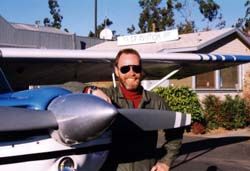 As a young(er) aerobatic instructor! As a young(er) aerobatic instructor!Photo by Jane Garvey (Belvoir’s … not the other one) |
Do you think that stalls are being taught improperly?
Pilots are goal-oriented people in general and you see that in the trainingprocess. “How soon did you solo?” “When did you get yourlicense?” “When this” and “when that?” If you’re goingto be in aviation for the long term, it shouldn’t matter if somebody is sittingnext to you for ten hours or a hundred hours. So I think students andinstructors should take more of a long-term, patient attitude, and focus on thelearning instead of the hours. I think more useful learning would take place.The worst thing we can do is to hurry along and force the issue. We run the riskthat the student will get frustrated and quit. Then we lose somebody who couldhave been in aviation for life.
It’s also important to practice the art of slow flight. Learning to becomemore comfortable with the stall and the recovery. For aerobatic pilots the stallis something that interferes with us trying to finish a loop or some othermaneuver. You have to deal with the stall and continue with the aerobaticmaneuver, whereas in primary training the stall is a distinct and separateevent. But in the typical accident scenario just like in aerobatics, theaccidental stall is appears during some other intended maneuver or event, liketakeoff.
The FAA says we spend about 83% of our time in the cruise and descent phaseof flight, but only about 20% of the accidents occur there. We spend 6% of ourflight time in takeoff, initial climb, approach to landing and landing, butnearly 60% of the accidents occur there. And there are other stall-relatedproblems, too. If a pilot’s uncomfortable with stalls, for example, he maysimply fly faster. On a shorter runway the extra speed may cause the pilot tooverrun. Yet the underlying problem is really stall-related.
So I think it would help to spend more time on stalls and slow flight. Also,we generally teach two kinds of stalls – power off and power on. But accidentalstalls don’t always happen at those extremes. I think it’s a good idea to teachpartial-power stalls, too, and gradually build up to a full-power departurestall. I think moving up the stall ladder gradually gives the pilot a chance tocatch up with the process, to see what’s happening, and it isn’t as intimidatingas moving from one extreme to the other.
Most instructors are prepping for the practical test. That’s not to say thatthere aren’t a lot of good instructors who do a lot of good things above andbeyond that, but it goes back to that goal-orientation thing. ‘This is thechecklist. These items are what determine whether you get a ticket or not.’ Sonaturally those are the items of focus during the training. But there are thingsaround the focus that we can do to make pilots safer.
The art of slipping is one example, and something else pilots can and shouldpractice. In the EMT Program we dedicate one whole flight to slipping. I’vediscovered that a lot of pilots get their slip training the day before theircheckride, when the instructor remembers that he hasn’t shown it yet, and that’sabout all the exposure the student gets to it. But if you have a control jam,you may need to slip to keep control of the airplane. We do stalls during theslip, and then return to the airport for a few slips to landing.
Where is the aerobatic training area for Santa Paula?
We fly in the valley between the airport and the Fillmore VOR. The airspaceabove the valley is waivered for aerobatics, so we have to be in that valley.Because of the airways, terrain, and other nearby airspace, we can’t just goanywhere we want to do our training.
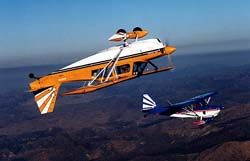 Flying inverted during a formation photo shoot Flying inverted during a formation photo shootPhoto by P. Gregory Smith |
Where do the students from Van Nuys and Burbank practice?
They’re in the same valley but further east, toward Magic Mountain and theI-5 freeway. We use 122.85 mostly to announce arrival and departure from thepractice area, but it’s a busy airspace and we encourage all pilotstransitioning the area to call on 122.85 to see if anybody’s using the aerobaticarea. It’s see and avoid. And because you can use this valley to fly between thecoast and the desert without talking to ATC, we sometimes see a lot of trafficpassing through.
Santa Paula itself is an interesting airport. It’s a 2,600-foot strip, thehangars are pushed up close to the runway, and on the weekends you’ll haveairplanes taxiing on both sides of the runway. The afternoon winds can kick upto 15 knots, which can be a handful in a tailwheel airplane. You have to lineyour airplane up and keep it lined up and bring it right down the chute. That’sactually a benefit, by the way, of the training. You get to log some tailwheeltime as part of the experience.
Operating in the pattern here is different for a pilot from, say, Kansas,who’s used to being able to see forever, with nothing protruding above thehorizon line. Here we fly the pattern sometimes pointed right at the mountains,other times parallel but seemingly close to them. But if you cross over theridge and go to Camarillo airport, you’ve suddenly got a 10,000-foot strip inthe middle of flat, agricultural ground.
Should spin training be part of primary or commercial training?
That question is debated all the time on the newsgroups and elsewhere. Thereare really two issues. One, is spin training beneficial, and two, is itpractical to reintroduce it into the training curriculum? I think it isbeneficial if we define spin training as training that’s integrated with typicalaccident scenarios, and that involves not just intentional one-turn spins leftand right, but also the scenarios that lead to the spin, and unusual attitudespins. If the pilot has some tangible idea of the consequences, not only ofspinning airplanes that aren’t approved, but also of not being precise with thecontrol inputs during the recovery sequence, then the answer is yes, spintraining is beneficial. But just going out and doing one-turn left and one-turnright spins, completely divorced from how they relate to a skiddingbase-to-final turn, for example, is of no real benefit in the end. The FAAfunded their own study back in 1976 which concluded that spin training – asI’ve loosely defined it – is beneficial in reducing the number of inadvertentspins. Why no one talks about that anymore I’m not sure.
So I’d say if you properly define spin training, it is beneficial, but yetit’s not practical to reintroduce it across the board without putting it incontext. Today’s flight instructors are really not capable of teaching spins. Ina study published in 1993 that evaluated the stall/spin awareness of flightinstructors, 98% of the respondents said that their formal spin trainingconsisted of zero ground instruction and a total of one spin to the left and oneto the right. By comparison, we’d say it would be ludicrous for a CFI to becomea CFII with no formal ground instruction in instrument flight, and a total ofjust two instrument approaches. The spin environment is just as psychologically,aerodynamically and tactically demanding as the instrument environment. Youcan’t afford to make mistakes in either one. Unfortunately, flight instructorsgenerally are not qualified to teach spin training as I’ve defined it. Then youhave to tackle the issue of suitable spin training platforms-there just aren’tthat many available on most flight lines. Then you get into insurance andairspace issues, and as a whole, it’s not practical. There aren’t a lot ofplaces, especially in southern California, where you can do aerobatics without awaiver, either. And getting to areas where spins and aerobatics could be donelegally might impose undue hardship on some flight schools.
But, there’s certainly nothing wrong with encouraging, without requiring -and the FAA is starting to recognize this as well – that a pilot should take athree- or five-hour spin training course. Overall, that’s not a lot of trainingtime, but you’ll learn a lot even in that short time.
Do you have students from outside the U.S.?
I train a lot of Swiss pilots. They’re teenagers. I train them before they gointo the Swiss military. And I’ve trained a a lot of Japanese students. I’vetrained so many Japanese students that groups of them have brought me to Japanto fly with them using their airplanes. Some of my students in Japan have justtranslated my EMT book intoJapanese.
How friendly is the Japanese government towards aerobatic instruction?
It’s very restrictive. Also very expensive, which is why they come here. Theflying club that I dealt with in Kumamoto, in southern Japan, was great. Thecontrollers were great, mixing in a four-seat aerobatic-capable airplane with747s and other large jets. One day we were grounded because a typhoon was comingthrough, so the flying club got a tour of the ATC facility. The controllerswanted to learn as much English as they could from me, so it was fun trying toexplain certain phrases to them.
I also got to fly a couple of times in Indonesia, which is another story.There’s virtually no GA in the country. Its area is huge, there are about 250million people, and at the time there was just one aerobatic airplane in thecountry, which belonged to the son-in-law of the President of Indonesia. I wasthere to do an air show. All the airports are controlled and I practiced out ofan airport in the middle of nowhere that had one scheduled flight a day. I wasthere alone, except for Indonesian mechanics. I would go flying each day withoutfiling the required flight plan, and I’d fly by the tower with the smoke on andask the controller how the maneuvers looked. It was ironic that in a countrywhich stifled general aviation that, because of the political connectionssurrounding my being there, I had absolute flying freedom.
How do you handle language issues when you’re instructing?
Language usually isn’t too much of a problem with the foreign students. Whenthings turn to worms in the cockpit, nobody understands anything anyway. EvenAmerican students sometimes have trouble telling left from right. What Isometimes do with foreign students is to ask them to give me, phonetically, somekey words in their language, then I tape the list to the back of their seatwhile we’re flying. When we’re upside down it’s easier for me in the back seatto work in their language using the list than it is for them to try to translateEnglish into their own language.
As far as my students here, most of the people I fly with are between 25 and50. The typical GA pilot. In between ratings. A little nervous about stalls andspins. About two weeks ago a fellow came in who first started flying in 1939. Hesaid he wanted to fly safer. I said, “You’ve been flying every year for 60years, so you must be doing something right – maybe you ought to be instructingme.” His attitude – always willing to learn – is probably why he’s hadsuch a long and active flying career. A while back I flew with a 76-year-oldwoman, a Santa Barbara Ninety-Nine, who had flown her Archer across the Atlanticto Germany. She had flown that Archer all over the place.
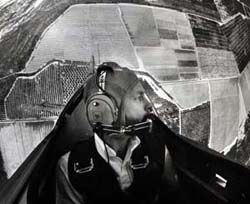 Going vertical in the Pitts for an L.A. Times article Going vertical in the Pitts for an L.A. Times article |
Short of taking a course, what can pilots do by themselves to become moreproficient?
If you’re on an extended cross-country, where you’ve been sitting for acouple of hours, practice slow flight before you get to the airport. This isparticularly true when ferrying aerobatic airplanes, where your legs and armscan get stiff. Do some steep turns to loosen up your arms and legs a little.You’re going to have to be active in the pattern, so get ready for it before youget there. And why not do a couple of takeoffs and landings at your destinationto get the hang of the new airport?
Try practicing normal power-off stalls without adding power during therecovery as well. Pretend you’re a glider. Break the stall and recover in awings-level glide, without rushing to add power.
You should do this one with an instructor before you try it alone, but youcan actually do an entire stall just looking out at the wing tip. From entry tobreak to recovery. When you can do that, next try the whole stall process withyour eyes closed, recovering just by feel – you definitely want an instructoralong for this one.
When you encounter an accidental stall, who knows where you’re going to belooking. You might be checking a chart, or looking under the panel, so it’s goodto be able to react and to recover instinctively, just using feel. Feel thecontrols, if they’re tight, you have energy that you can use. If they’re loose,you don’t have any energy, so you have to do something to get energy.
Being this close to LA you must get some celebrity pilots. Want to namedrop a little?
Pat Harrington – who played Schneider on “One Day at a Time” -took the course. He flew a P-210 and was able to get an insurance break fromtaking the course. Lorenzo Lamas did the whole aerobatic course. He flies aSeneca V. While I was doing a spin training class in Colorado, I flew anabbreviated course with Rick Schroeder. So, yeah, we get celebrities in herefrom time to time.
Are you doing any competitive flying now?
That’s on the back burner for now. Since I started instructing full-time I’vebeen concentrating on that. Right now I’m plane-less, but I’ve trained a lot ofpilots who are flying competitions. I initially trained Vickie Cruse – herfirst high-performance airplane was a Christen Eagle. It’s still based here, butshe now owns one of the Zivko Edge 540s with 345 horsepower. She’s going to theU.S. Nationals in September to fly Advanced. A couple of years ago she was theSportsman U.S. National Champion. So right now I’m watching former studentscompete and enjoy their airplanes, but I would like to return to competitionmyself someday.
Any advice for pilots looking at flight instruction as a career?
You probably won’t get rich as a CFI, but I know you can earn a living at itif you’re dedicated to it as a profession. That’s what NAFIis all about – elevating instructing as a profession while making a living atit. But also look at the role models who show what’s possible as a dedicatedflight instructor – John and Martha King, Bill Kershner, RodMachado – all have developed their reputations and earned decent livings asflight instructors.
My books and videos certainly help out in this regard. At the same time, Inever would have guessed that from my mechanical engineering background I’d endup flight instructing, publishing my own books and owning my own video series.And yet I’ve never taught primary flight training! I’ve only taught tailwheeltransitions, spin training, emergency maneuver training, and aerobatic training.I’ve been able to find my niche, and that’s about all any of us can ask for.
Rich Stowell’s books and videos areavailable at the Emergency Maneuver Training website
