










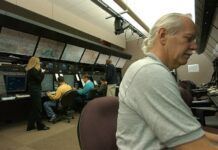






 Welcome back aviation fans. Your friendly safety rep here, Mr. Sunshine. I’m pleased to report to you that all is well and everything is coming up roses. Everyone on both sides of the mic has heeded my advice and we are all using perfect phraseology. Controllers are sticking to all the procedures and the pilots are all obtaining the best and latest forecast. They’re even filing an appropriate route including the preferential route. We’ve had no near misses, no operational errors, not even an operational deviation. Things just couldn’t be better at Atlanta Center. We even have D-sides plugged in at all the sectors.
Yeah right pal.
It’s been a heck of a week at Atlanta Center. As I told you in “SayAgain? #8: Air Traffic Chaos,” thunderstorm season makes me crazy. Evidently I’m not the only one. We had about a half-dozen deals (operational errors) this week. That means we’ve had more than six controllers pulled out of the control room at various and assorted times while initial investigations were done. That also means that there were probably a few pilot deviations filed too.
I bet that got your attention didn’t it? It’s one thing to have a discussion about vague safety principles and good operational habits. It’s a whole different ball of wax when we start talking about punching your ticket isn’t it? Those with visions of captain’s stripes in their head get real upset about violations. I got an earful about that subject from our pilot friends at the Communicating for Safety conference last month.
Well guess what folks? Many times when a controller has a deal the FAA starts looking at the pilot too. Because of the system we have, someone must take the blame. Controllers are the easiest to get to. We’re in-house, everything we do and say is recorded and there are so many rules that we’re bound to have broken at least one. While our pilot friends are concerned about changes to the “interpretive rule” we controllers are buying deal after deal.
Staying Focused
Before your mind starts heading off into the wrong direction let me say this. I’m not worried about who buys what or who gets blamed. I’m worried about the fact that two airplanes got too close together. That’s my problem. That’s where my heartburn comes in. Solve my problem and all those other problems go away. To paraphrase what I’ve told more than a few controllers, thinking “safety first” can save you on the front end instead of having to pay some lawyer to save you on the back end.
Just how big of a problem is it? Atlanta Center has been running a readback awareness program for about two years. You may have read about it in AVweb’s Newswire some time ago. It’s called “Catch a Bad Altitude” (CABA), the emphasis being on catching an incorrect altitude readback. Controllers who catch bad altitude readbacks can fill out forms and their names get thrown into a pool for the prize of the month. We had over a thousand forms filled out last year.
An impressive number huh? What you need to keep in mind is that I don’t participate in the program. Neither do many of the other controllers at Atlanta Center. So the number of incorrect altitude readbacks is probably twice as large. And don’t forget, that’s just the ones that we catch.
Playing With Numbers
 Anybody want to play the numbers game? There are 20 Air Route Traffic Control Centers in the United States. Conservatively, that’s 20,000 airplanes going to the wrong altitude per year. Want to toss in the Approach Controls? At the Centers, we’ll have numerous aircraft fly through the entire Center without changing altitudes. You can’t say that about most Approach Controls.
Once a month management sends us upstairs to the training department to read a short analysis about recent operational errors. When you read about these incidents it always crosses your mind, “What were these people thinking?” Sometimes you’re left wondering if they were thinking at all. Because I’m a safety rep and I read more of these things than most folks (yes controllers, I actually read them) they all seem depressingly familiar.
Let’s look at last month’s.
1) A pilot at FL280 is issued traffic at FL270. The pilot reads back something and then descends to FL270 right into the traffic.
2) A pilot checks on the frequency. The controller is expecting another aircraft from the same company. Using the callsign he is expecting, the controller issues a climb clearance. The pilot checking in is expecting a climb clearance and using his correct callsign, acknowledges the clearance and climbs. In other words, everyone is using the correct callsigns but no one is hearing.
3) A controller issues FL310 and the pilot reads back FL210.
4) A controller issues 16,000 and the pilot reads back 6,000.
Let’s dispense with number 3 and 4 at the same time. The analysis we’re given doesn’t address it in enough detail but I’ll make a wager that this is what happened:
For number 3 the readback on was probably “(click) one zero, Airliner 123.”
The readback on number 4 was probably “(click) six thousand, Screamer1.”
Five bucks says nobody said “leaving” or “descending to.”
If you don’t understand the (click) reference go back and read “SayAgain? #4: Tape Talk” so you can be depressed too.
Seven Come Eleven
What’s interesting is that controllers are so used to the phenomenon of pilots cutting off the first word of their transmission that even when the first word isn’t cut off, controllers think it was (or don’t notice). Management, in this case, recommended that we restate the altitude in group form per the 7110.65. “Screamer one descend and maintain one six thousand, sixteen thousand, altimeter two niner niner two.”
Not a bad idea. As a matter of fact, I know the guy who took the idea and had it incorporated into the 7110.65 so controllers could use it. But just to show you how a good idea can go bad let’s look at what has happened. The other day I was working the arrivals and at some point in time, I had to issue the following to every inbound.
“Airliner twelve cross DAFIX at and maintain one one thousand Airdrome altimeter three zero zero two.”
Every single one of them – not half, not most, not almost all of them – every single inbound during the push read back “eleven.” Some of them didn’t even bother adding “thousand.” Right now at least a dozen guys (pilots and controllers) are saying, “So what, that’s not so bad.”
(click)ven thousand
(click)ven thousand
Which one is going to eleven thousand and which one is going to seven?
Teen Agers
 I don’t mind them saying “eleven thousand” as long as they say “descending to one one thousand” first. Really, I don’t. I don’t mind them saying “fourteen thousand” as long as they say “descending to one four thousand” first. I swear it doesn’t bother me. Really. But it annoys me to no end when I hear “(click)teen thousand Airliner twelve.” I’ve got an idea. How about saying anything first except your assigned altitude? “Uhhhh” will work. So will your callsign, “descending” or “leaving.” I bet the AIM has a suggestion that will work.
Number 1 and 2 are real head-scratchers. Unfortunately neither one is unique. It’s way too easy to slough it off as people deciding to be dumb. That in of itself is stupid. The people involved really aren’t trying to put two airplanes together. They’re doing their best to keep them apart. So what happened?
Again, the analyses we are given raise more questions than they answer. How busy were the controllers? Was the radio reception good? Again, we’re left to guess. That’s okay with me, my guesses are pretty good after this many years. The pilots both wanted a different altitude and heard what they wanted to hear. The controller had their plan and both heard what they wanted to hear. It’s not a very scientific way of putting it, but it’ll suffice for my purposes.
ATC And Mom
Haste makes waste. Did your Mom ever tell you that? I swear my mother could have been an air traffic controller – well, at least an instructor anyway. It’s so easy to get into a rush as a controller. I’ve noticed that when a controller gets busy and starts talking too fast the pilots follow suit. If your friend jumps off a cliff are you going to too? It doesn’t take a genius to figure out that talking fast isn’t conducive to solving the hearback/readback problem. Even my Mom could figure that one out.
The solution is as obvious as it is simple. Slow down. Right here, every controller from Atlanta Center (and probably every other facility in the country) is saying to themselves, “We can’t slow down. There’s no way we can move this many airplanes if we slow down.” I don’t agree with that sentiment but I’ll play along for a minute. Let me ask a question. How fast are you going to have to talk to work 10,000 airplanes a day? How about 11,000? Or 15,000? Do you think talking faster is going make that work too? Chew on that for a little while as we move on.
Number One
On the pilot side of things it’s just amazing to controllers that number 1 happened, much less that it’s not the first time we’ve seen it. As bad as some of the phraseology is that I hear controllers using these days, I can’t recall a controller calling traffic to another aircraft without using the word “traffic.”
“Airliner 123 traffic twelve o’clock five miles opposite direction flight level two seven zero a Boeing seven thirty seven.”
Does that sound anything like “Airliner 123 descend and maintain flight level two seven zero,” to you?
Of course we all would need to use standard phraseology if we’re to develop the habit of keying into hearing certain catch words like “traffic,” “leaving,” “climbing,” “heading,” “speed,” etc., etc., etc.
Temptation
 It’s really tempting to come up with a knee jerk reaction to these kind of incidents. I know some controllers who have had this happen to them before and they just don’t call traffic to airplanes that don’t have good radios or a decent command of the English language. Some restate the altitude to maintain with the traffic call. I also know some pilots and some controllers who don’t understand why we call traffic in the first place.
You’ve probably heard the saying that the checklists are written in blood. Much the same can be said for the controller’s 7110.65. Back in the early jet age there was a midair collision between two airliners. The gist of the accident was that two airliners were legally separated. Due to an optical illusion, the aircraft below climbed right into the aircraft above because they thought the traffic was at their altitude. Hence the requirement to call traffic/apply merging target procedures. According to ATC folklore that is.
Which brings up an interesting point. Just yesterday (I don’t write these columns in one day you know) I was upstairs for my monthly refresher training and one of the subjects just happened to be merging target procedures. The lesson lasts about three minutes as a multimedia presentation on the computer. It’s dry as toast and boring as watching paint dry. It’s also the same lesson that I see year after year. In other words, your average controller daydreams his way though it. And the lesson never mentions why we call traffic.
Why Oh Why?
That’s a bone I keep picking over and over. The “why” behind the rule. I understand that we don’t want to load every student pilot or controller up with a million war stories during their initial training. They have a lot to learn already. But students invariably want to know, “Why?” “Because I said so,” stops working after a while. Just ask my Mom. Sooner or later it’s in our best interests to start explaining the reasons behind the rules. It’s a lot more interesting too.
I’ve had more than one pilot over the years confess that they believe controllers call traffic as a “courtesy.” Nope. That’s not why. There are several reasons and I bet that I don’t even know all them. The simplest one is that it makes us look. Controllers look at the scope and pilots look out the window. It lets pilots know that there is an aircraft in close proximity that warrants their attention. It’s that situational awareness thing people are always talking about. It provides one last chance for everyone involved to make sure the aircraft are separated.
Talk It Out
I was just having a conversation with another controller and he brought up a point that I hadn’t really thought of. Think back to the broadband radar days before Mode C readout. The only way you knew the altitude of an aircraft was by pilot reports. That “last chance” takes on new meaning doesn’t it? I bet their phraseology was better back then. They depended on it more. Can you think of more reasons (besides the fact that it might keep you from descending into another airplane)? The next time you hear the word “traffic,” sit up and pay attention. Mom says so.
Remember when I said you should take the opportunity to talk about these things when you’re getting your currency in hangar flying? You’d be surprised what you might learn. Sure, controllers look at me funny every time I start talking about air traffic control when we’re out on break. But they get over it. And they start thinking. The next thing you know they’re teaching me something new.
Crunchy Numbers
 Have you controllers been chewing on the numbers I mentioned? I told you I’d get back to them. Can you imagine what it’s going to be like working 15,000 operations a day? If our operational error percentage stays the same we’ll be having 100-150 operational errors per year. Instead of being able to count the number of operational errors you’ve had in your career on one hand, you’ll be using two, no matter how fast you talk. The number of pilot deviations the FAA files will go up correspondingly too.
We’re not only going to need some new equipment and more people to handle the volume, we’re going to need to change some procedures and invent some new ones. In order to do that we’re going to need to know what works in our system and what doesn’t. I can’t tell you that standard phraseology and good radio technique will be able to handle that kind of volume. I don’t see enough people using them to be able to tell. I can tell you that talking faster and using non-standard phraseology won’t work. We’ve already proved that. So, straighten up and fly right – or I’m telling Mom.
Have a safe flight!
Don Brown
Facility Safety Representative
National Air Traffic Controllers Association
Atlanta ARTCC
