
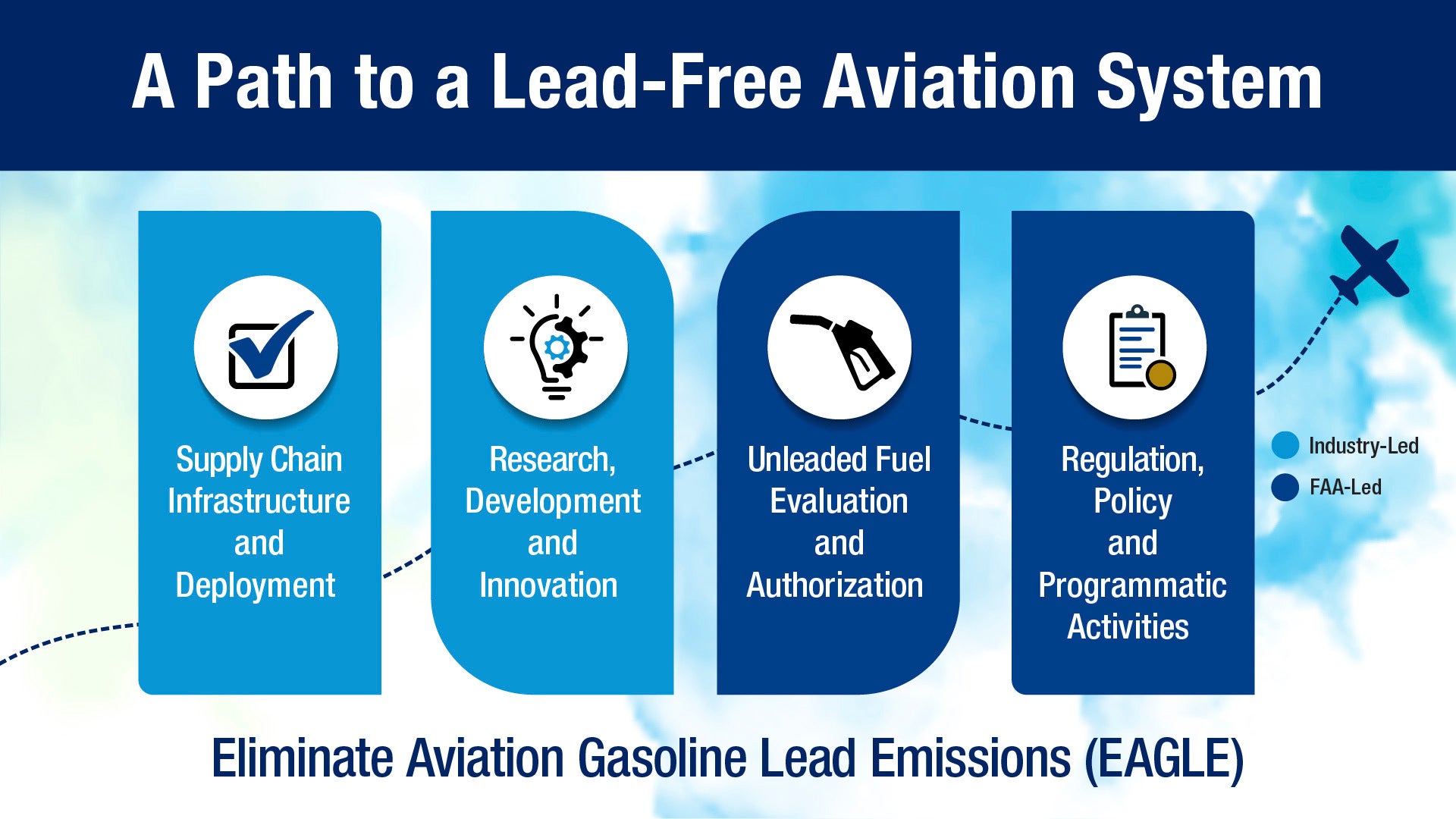

In anticipation of an imminently expected endangerment finding from the Environmental Protection Agency (EPA) on leaded aviation gasoline, the General Aviation Manufacturers Association (GAMA) hosted an industry-centric “background” briefing for aviation press this morning. GAMA was clear from the beginning that this was an industry-only briefing and did not come under the “umbrella” of the Eliminate Aviation Gas Lead Emissions (EAGLE) initiative, described by GAMA as “a comprehensive public-private partnership consisting of aviation and petroleum industry and U.S. government stakeholders.”
Representatives from GAMA, the Aircraft Owners and Pilots Association (AOPA), Experimental Aircraft Association (EAA) and the National Air Transportation Association (NATA) participated in the discussion.
The panelists cited progress toward fielding a replacement for 100 low lead (100LL) high-octane gasoline that would be suitable for fleetwide use. While an estimated 70 percent of the current piston-aircraft fleet can safely use available lower-octane lead-free fuels, the remaining 30 percent that require higher-octane fuel to operate safely fly an estimated 70 percent of the hours flown by the entire GA fleet.
The panelists noted that the expected EPA endangerment finding, in itself, does not constitute a ban on continued use of 100LL fuel. In fact, the group stressed the priority of retaining the right to distribute and use 100LL until an acceptable replacement is in place.
However, the panelists did acknowledge that the EPA endangerment ruling does set a “pathway” to future rulemaking related to lead emissions in aviation fuels.
There was extended discussion on the difference between the supplemental type certificate (STC) route to acceptance of a replacement unleaded fuel and the so-called ASTM (American Society for Testing and Materials) route, involving a “collaborative government FAA program to test candidate fuels, generate report and data, and distribute to fuel providers,” enabling the FAA to gain “industry consensus” and issue a fleetwide approval.
The panelists were careful to assure that the FAA, as the arbiter of safe aviation operations, is the final authority on approving a replacement for 100LL, not the EPA. That said, the discussion revealed that—for the first time—regulatory standards for lead emissions in aviation fuel will be established as a result of the expected EPA endangerment finding. GAMA assured the participating journalists that there would be further briefings once the EPA endangerment finding is finalized.